


No memorial may be introduced into this Churchyard without permission, which will only be granted in accordance with the Diocesan guidelines.
Burials
St George’s Churchyard is subject to the Diocesan Churchyard Regulations which are designed to help Clergy and their Parishes adopt good practice in the management of burial grounds in Churchyards.
All requests for burial for persons must be made in writing to the Parish Priest or, during a vacancy, the Area Dean for their consideration.
For all burials a ‘pre-burial form’ must be completed. This can be obtained from the Parish Priest or, during a vacancy, the Area Dean.
Interment of Ashes
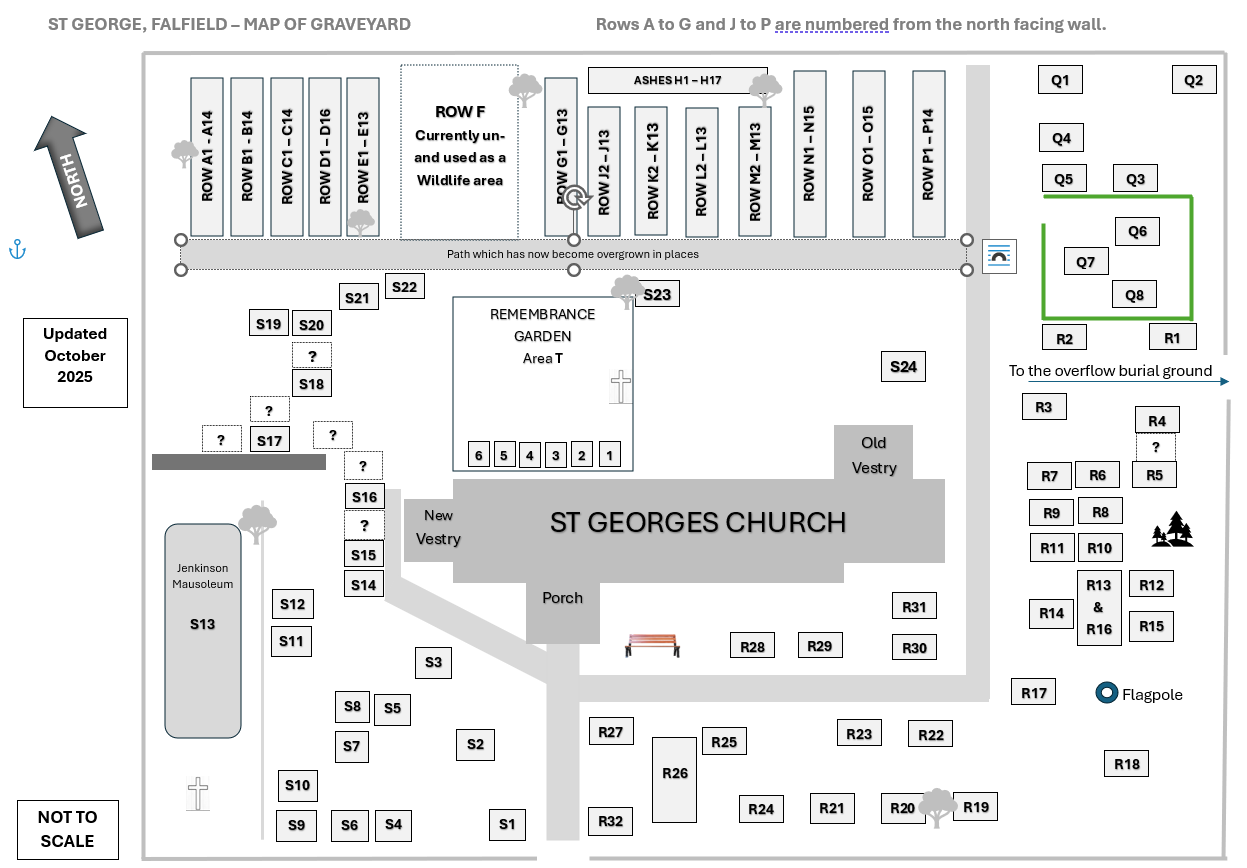
It has been agreed that ashes will be interred in a designated area for ashes on the north side of the church building. Ashes may also be interred in the graves of the family.
An application form for this is available from local funeral directors. Interment of ashes without permission is not allowed. The scattering of ashes is also not permitted in any circumstances within the Churchyard.
Memorials / Headstones
If a memorial stone is required, an ‘Application form to introduce a Memorial into a Churchyard’ must be completed and returned to the Parish Priest or, during a vacancy, the Area Dean. This is available from the local funeral directors. They will advise on acceptable size, material and wordings.
Applications for headstones will only be accepted by the Parish Priest or, during a
vacancy, the Area Dean at least six months after the burial, thus giving the ground time to settle.
Maintenance of graves and headstones
This is the responsibility of the family of the deceased. The family may wish to take out insurance against damage to the headstone. St George’s PCC retains the right to remove any unsafe or defaced headstones after consultation with any known family members.
The grassed area between the graves is the responsibility of the Church.
• Bulbs and small annual plants are acceptable when planted in the soil of any grave (but not in any container).
• Potted plants and vases of flowers should be placed near the headstone and removed once dead. Except where the design of a memorial/gravestone includes an integral vessel for plants or cut flowers, flowers may only be placed in a removable container. If a flower vase is the only memorial, it should be fixed securely to a foundation stone flush with the ground.
• The planting of shrubs and trees, either on graves or elsewhere in the churchyard, is not allowed without the agreement of the PCC and the consent of the relevant Archdeacon (to be provided by way of a written notice following consultation with the Archdeacon). Any planted without permission may be removed.
• All wreaths, memorabilia and toys must be removed from graves within a month of the burial. One suitable toy or tribute may be placed on the grave of a child (i.e. a person under 18 years of age) provided that it is removed after a period of 6 months.
• Silk or other artificial flowers are not allowed except for Remembrance Day poppies and traditional Christmas wreaths. These should be removed by Jan 31st.
A Parish Priest, Churchwarden or whoever is authorised by the PCC to look after the Churchyard is permitted to remove unsightly wreaths, flowers and any items not permitted by these Regulations and any other permitted items if they consider they are not maintained to an acceptable and tidy condition.
We are aware that some graves may not conform to the above regulations at present. We would respectfully ask that steps are taken to do so, if they do not comply with the above.
A copy of these Regulations is available on request. Families will usually sign a copy of these Regulations before a burial or the interment of ashes of loved ones. Further information may be found on the Diocesan website - https://gloucester.anglican.org/Parochial Church Council (PCC)
St George Church Falfield
September 2025