







To: all in the Diocese of London
'And she brought forth her firstborn son, and wrapped him in swaddling clothes, and laid him in a manger; because there was no room for them in the inn.'
Luke 2:7
In her book ‘Journey to the Manger’, Paula Gooder reflects on that well-worn phrase from the Christmas story, ‘no room in the inn’. (and there is a video here) She explains that in using the biblical Greek word, kataluma, Luke is not describing the first century equivalent of a Premier Inn, but rather a guest room in a house. Sometimes this would be an entire upper floor, such as the one in Jerusalem used for the Last Supper. In smaller homes it would simply be a corner of the one-roomed house in which a family lived.
Inns were only needed in remote places, and certainly not in towns and villages, because as Paula explains, ‘Rules of hospitality dictated that people – even entire strangers – should be welcomed into your home and cared for’.
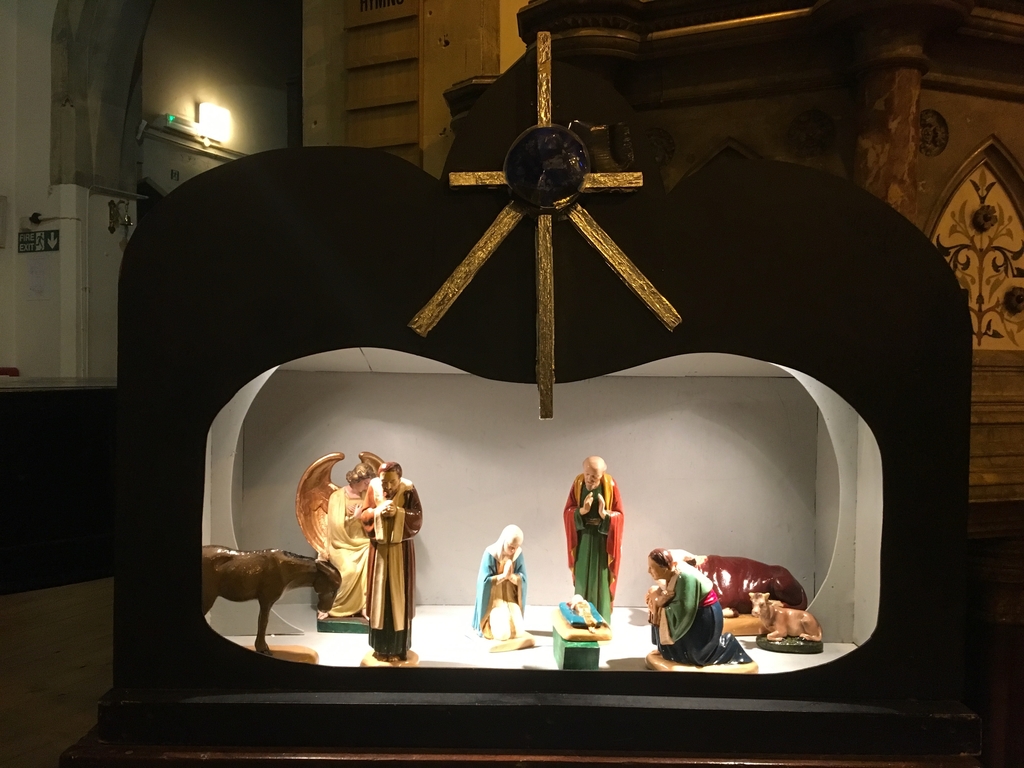
But when Joseph and Mary arrived in Bethlehem, exhausted from their journey, Mary perhaps already in labour, all the kataluma – the guest rooms - were full. So the family who offered them hospitality took them into their own space, where in cold weather the animals would also be housed - hence ‘they laid him in a manger’.
What difference does this make to our understanding of the story?
Well, it does away with our childhood impressions of grumpy innkeepers and slamming doors, and the dubious and begrudging offer of a stable for the birth. Instead, this is a town which has already absorbed countless people coming in for the census, and a family who do not baulk at the discomfort of overcrowding, the inconvenience and mess of an imminent labour, and the presence of an anxious and vulnerable couple in their human- and animal-filled home.
This is a story of generous and selfless hospitality towards distant relatives or total strangers; costly hospitality, demanding people’s time, patience and the willingness to be deeply inconvenienced as they hitch up and make space for this vulnerable young couple and their baby. As Paula points out, nobody refused Jesus room, ‘he just didn’t quite fit in’. And yet they made it possible.
This Christmas, there are individual homes, faith communities and charitable initiatives where strangers who don’t quite fit into the neat nuclear structures of our societal arrangements sit down to share food, stories, longings, tender care and raw human connection. Regardless of relationship, belief, place of origin, social class or financial means, all are welcome. And there, with fragile tenacity, Christ is born once again. Present among us, in people whom society has isolated, forgotten or ignored, where inconvenience is over-ridden by loving hospitality.
How we respond to one another’s needs and predicaments defines what sort of people we are, what sort of community we are building, what sort of society we want to be and what sort of God we believe in – whether and where we notice Christ’s presence and welcome him in.
I leave you with a prayer by the Irish poet and theologian, Padraig O’Tuama:
‘In all our hospitalities, help us
Give and take. May exchanges be
Warmed by hearts open to change.
Because this is how a God made
A home among a people. Because
This is how a people make homes
Around a newborn God.’
May your Christmas be blessed and peaceful.
+ Sarah Londin