
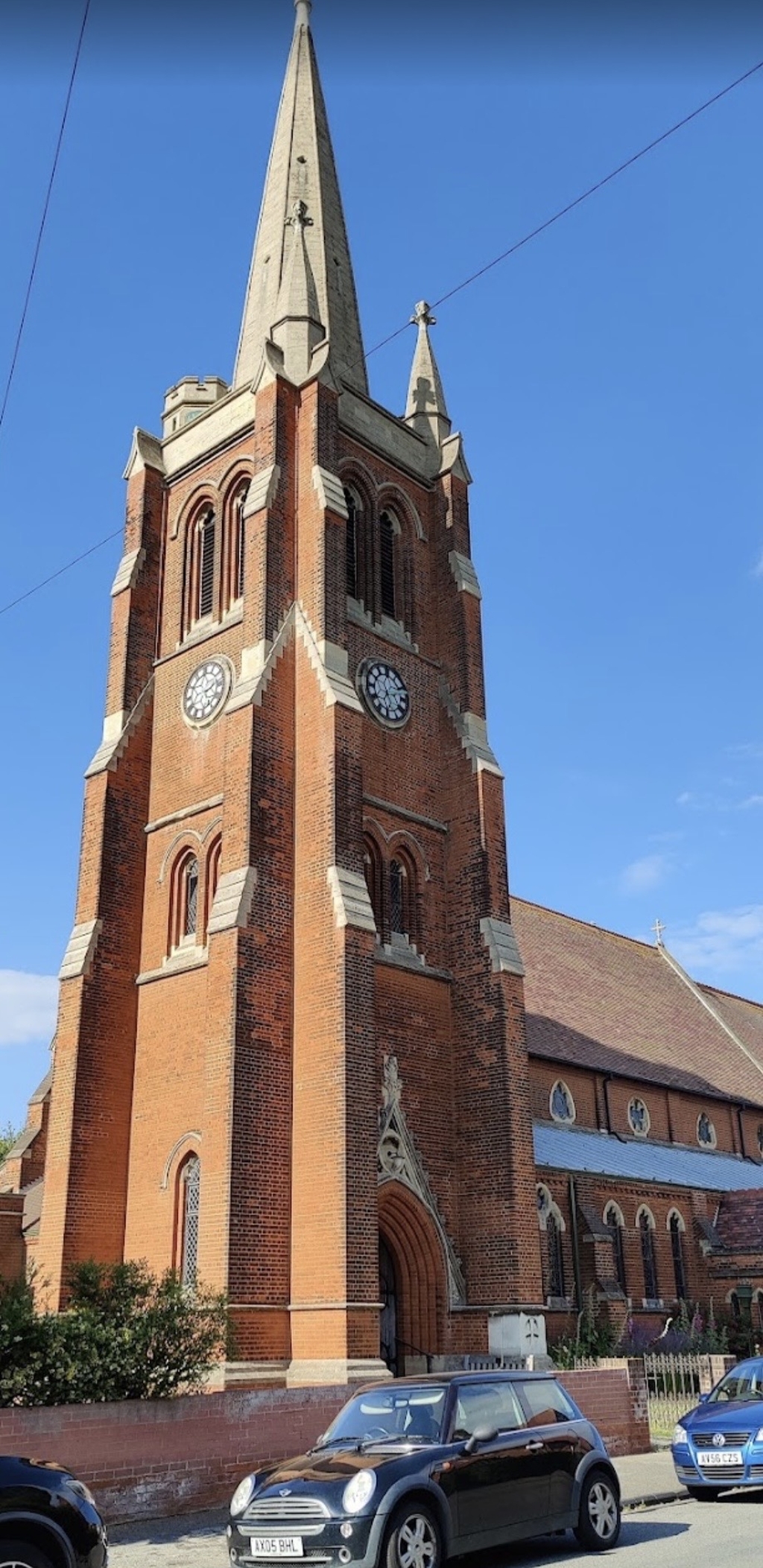
Farewell Service
“Helen asked each of us to choose our favourite hymn to sing at this Service and to give the reason for our choice.
We all love certain hymns both for the words and the tune (best of all when accompanied by Jeremy), and because they mean something special to us, often associated with important events in our lives.
As the hymn choices arrived, I saw a pattern forming, and I want to share it with you.
Hymns sung by the congregation are relatively recent in the 2000 years of the church’s history, and we can thank our Lutheran Brethren and the Reformation for the great chorales which we still sing today. Sylvia has chosen one of them, “Now thank we all our God” for the best of reasons, it was sung at her and Ted’s wedding. Like most of us, Sylvia had been in church choirs all her life, here at St John’s for a mere 17-18 years.
And we can’t have a service based on hymns without a Bach chorale. Nick has chosen Wake O Wake, with tidings thrilling, more commonly known as “Sleepers Wake”. Nick wrote this about his choice:
The text for this hymn has an unusual metre and absolutely keeps you on your toes as a singer. The harmonisation by Bach is a terrific example of his work – which I love – and the running bass line is interesting and great fun to sing. And then the text – what a drama it evokes providing a brilliant picture of the panic setting in when the bridegroom makes his entrance at midnight and everyone has to suddenly appear ready. As a chorister its good to hear that the song “swells loud and long”. And, or course, the underlying message is expressed with great eloquence and passion. Finally who doesn’t love a wedding! (Unless of course your one of those 5 foolish virgins and you’re excluded from the celebrations.)
Nick has been in the choir 35 years.
We have the Wesley brothers, particularly Charles Wesley to thank for importance of hymn singing in this country, and the music for my choice, “Christ is our cornerstone” was composed by Samuel Sebastian Wesley, Charles’ grandson. The words, originally in Latin, are thought to be pre-9th century. As a chorister it gives me a thrill to sing ‘O then with hymns of praise, these hallowed courts shall ring; our voices we will raise the three in one to sing, and thus proclaim in joyful song, both loud and long, that glorious name.” Oh by the way, I’ve only been in the choir sixteen years.
And now we’re in the Victorian era and I think my favourite composer of hymn tunes from this period is the great John Bacchus Dykes, so I was very pleased when Sonia chose ”Eternal Father strong to save”. As I am sure a lot of you know, Sonia was Wren, she was brought up in Southampton, she was stationed in Malta where she met and married Charles, also in the Navy. Charles was then stationed in Cyprus at the time of the EOKA troubles, and Sonia went with him. So her choice is rooted in her personal history. Sonia has been a member of the choir for about 30 years.
Jenny’s choice also comes from the Victorian era, “The day thou gavest Lord is ended”, a hymn that is still universally loved. Jenny wrote this about her choice: “My parents, being Salvation Army Officers, meant that Sunday was an extremely busy day for us as a family, but every Sunday, after the evening service, teenagers only were invited to come back to our house for a “get together” where we were able to wind down the day. We would chat about absolutely everything and sometimes drag in either Mum or Dad to answer some tricky subjects that might arise. We would often sing various songs, many in four part harmony which was a lovely sound most of us being able to sing or play an instrument, but no matter what had gone on during our time over tea and coffee and nibbles, we would always close the evening with this particular hymn” Jenny has been in the choir for 17- 18 years.
In the early years of the 20th Century the great composer Vaughan Williams, with others, was responsible for producing a hymn book (the English Hymnal) which aimed to merge England’s rich musical history, including folk songs, with contemporary worship needs. We find over twenty of his hymns in our current hymn book.
And so we come to Penny’s choice. “Come my way , my truth, my life”. She writes
“I was pleased to find this poem by the so-called “metaphysical” poet (and cleric) George Herbert in our “Complete Anglican Hymnbook”, in its setting by Vaughan Williams. He arranged Herbert’s “Five mystical Songs” which I have enjoyed singing with Ipswich Choral Society several times. Another of the five songs is “Let all the world in every corner sing” but Vaughan Williams’ tune for this is not suitable for congregational singing.”
Penny has been in the choir for 40 years. She was awarded a Bishop’s Medal for her services to St John’s choir, particularly during a period when she, Nick and Sonia were the only members.
And now we’ve come full circle, because George Herbert, the poet of Penny’s hymn, was writing at the beginning of the 17th Century, at the same period as the writer of “Now thank we all our God”.
I am going to end by quoting another George Herbertpoem, now a hymn:
King of glory, king of peace, I will love thee
And that love will never cease, I will move thee
Thou has granted my request, thou has heard me
Thou didst note my working breast, thou hast spared me
Wherefore with my utmost art, I will sing thee
And the cream of all my heart, I will bring thee
Though my sins against me cried, thou didst clear me
And alone when they replied, thou didst hear me
Seven whole days, not one in seven, I will praise thee
In my heart, though not in heaven, I can raise thee
Small it is in this poor sort to enrol thee
E’en eternity’s too short to extol thee
Liz Watson 6.9.26