South Raynham: St Martin
Welcome to St Martin’s, South Raynham
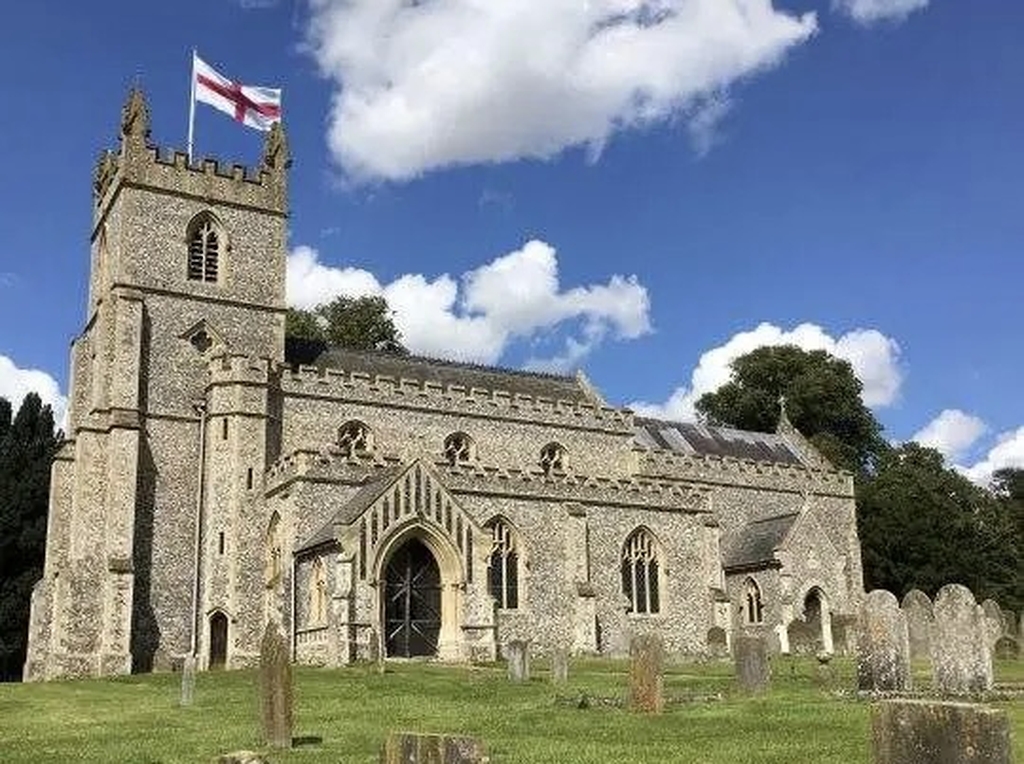
The setting of St Martin’s, South Raynham, is just about perfect. Lying on the edge of the Raynham estate and set well back from the nearest road, the church is shared only with the old Rectory next door and the cattle grazing in the fields that border the churchyard. It is perhaps best described as an obscure church rather than a remote one: easy to pass close by without realising it is there, though its tower briefly raises its head among the trees to those travelling along the higher road.
At the entrance to the churchyard stands a wrought-iron kissing gate of a type once common in village life, likely fashioned by a long-forgotten local blacksmith. Beyond it rises the tower, dating from the late 13th or early 14th century, with the nave and chancel probably rebuilt around the same time. Though the nave is now lined with impressive Perpendicular windows, closer inspection reveals earlier work: a filled arch in the east end of the south wall, now containing a Decorated window, hints at a lost chapel and suggests that much of the structure predates the fashion for Perpendicular tracery. The chancel, too, carries a thoughtful mixture of styles, pointing to a building gently adapted over time rather than entirely remade.
Inside, St Andrew’s feels every inch a rustic estate church. There are no grand memorials of famous names, such as those found across the fields at East Raynham, yet there is much to hold the attention and an atmosphere shaped by generations who have known this place as the heart of their community. The chancel arch is unexpectedly generous for so small a church, and the east window contains unusual mid-19th-century glass, designed in a highly pictorial, painterly style. Both Birkin Haward and the late Geoff Robinson believed it to be almost certainly the work of Charles Clutterbuck.
The art nouveau altar rails are particularly fine, but the most remarkable feature lies beyond them. Set once more upon the altar is the surviving mensa, or altar stone, edged with a dog-tooth pattern and carved perhaps two centuries before the present church was built. Thought by Pevsner to be 12th century — and possibly earlier — it belongs to the very end of the Norman period, if not before. This makes it the oldest surviving mensa in East Anglia, and among the oldest in England. For many years it served, unnoticed, as a step into the chancel, until it was recognised by Munro Cautley and restored to its rightful place in the 1980s.
Quietly significant, deeply rooted, and rich in memory, St Martin’s continues to offer a place of prayer, reflection, and welcome.
Whoever you are, and whatever brings you to St Martin’s, South Raynham, you are always welcome.