



Family Communion
- Occurring
- for 1 hour, 15 mins
- Venue
- Kidbrooke, St Nicholas
- Address Whetstone Road Kidbrooke London, SE3 8PX, United Kingdom
Family Communion for the First Sunday of Christmas: celebrant the Revd Tola Badejo.
First reading: Hebrews 2.10 – 18
Gospel: Matthew 2. 13 – 23
The Epistle to the Hebrews explains that Christ 'had to become like his brothers and sisters in every respect', meaning that he had to share all the worst things human life can deliver. The Gospel relates the terrible, but sadly by no means unique, episode called the 'Massacre of the Innocents', in which Herod ordered the killing of every child in and around Bethlehem who might have been the prophesied 'King of the Jews'.
There is no evidence beyond Matthew's Gospel to show that this massacre really happened, but that fact is potentially disturbing in itself. Bethlehem was a small community, and the number of boys under two would not have been large. From the viewpoint of contemporary historians, the crime would have been insignificant compared to the atrocities Herod undoubtedly committed, or the brutal violence meted out on a regular basis by those with the power to do so. The idea that something so appalling could be pushed to the side of people's consciousness must make us reflect on our own ability to look the other way when events are too disturbing.
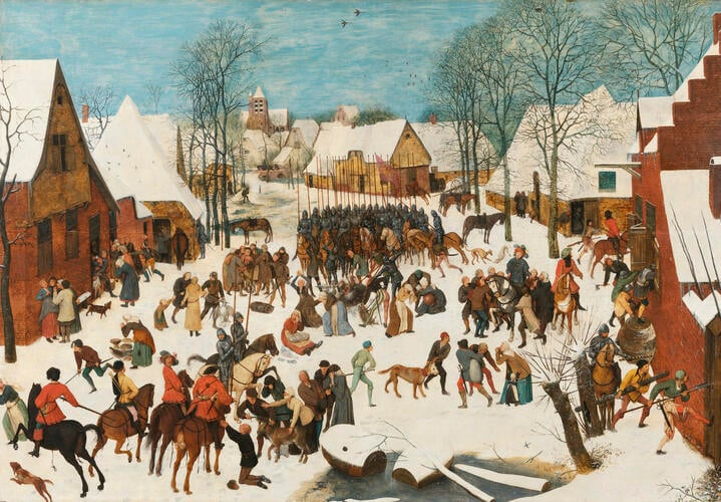
We can see some of these mental processes at work in the original version of Pieter Bruegel's 'Massacre of the Innocents' painting, which now doesn't show a massacre. Bruegel based the scene on contemporary events in the Spanish Netherlands: the Hapsburg emperor took exception to its depiction of his own soldiers as the perpetrators, and insisted that all the images of dead and dying children be overpainted with something less shocking, so that now we see the agonised response of the children's parents but not the reason for it. If anything, this makes the painting more universal and more powerful.