
History of St Lawrence's Church
founded 1531, extended 1872
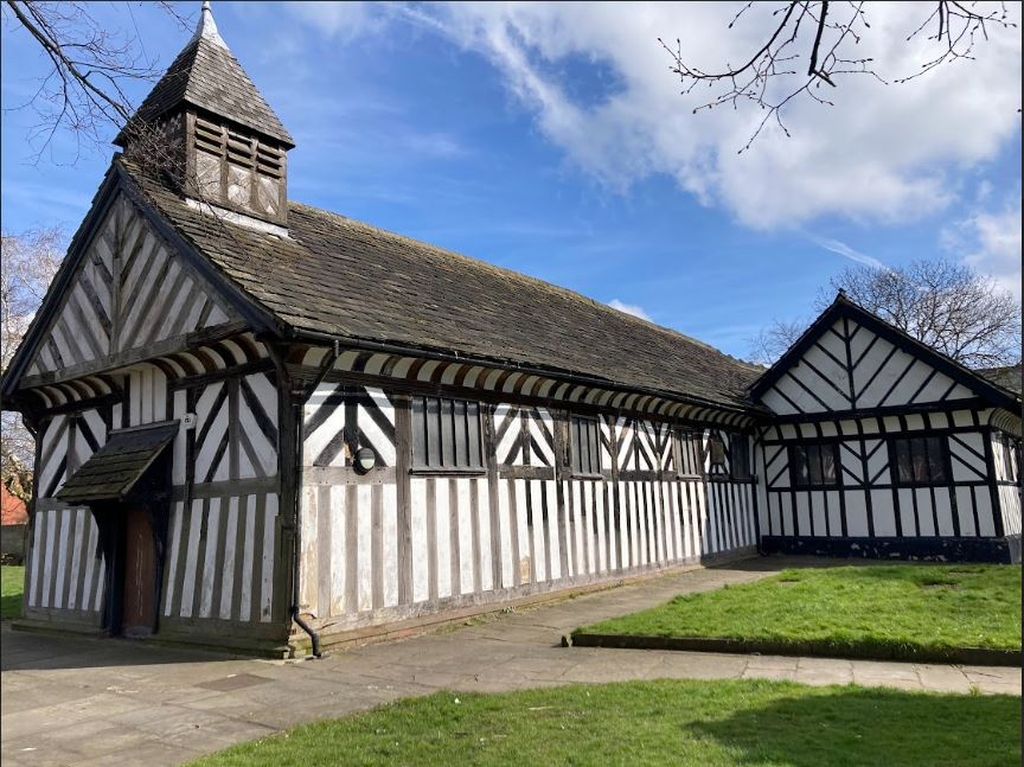
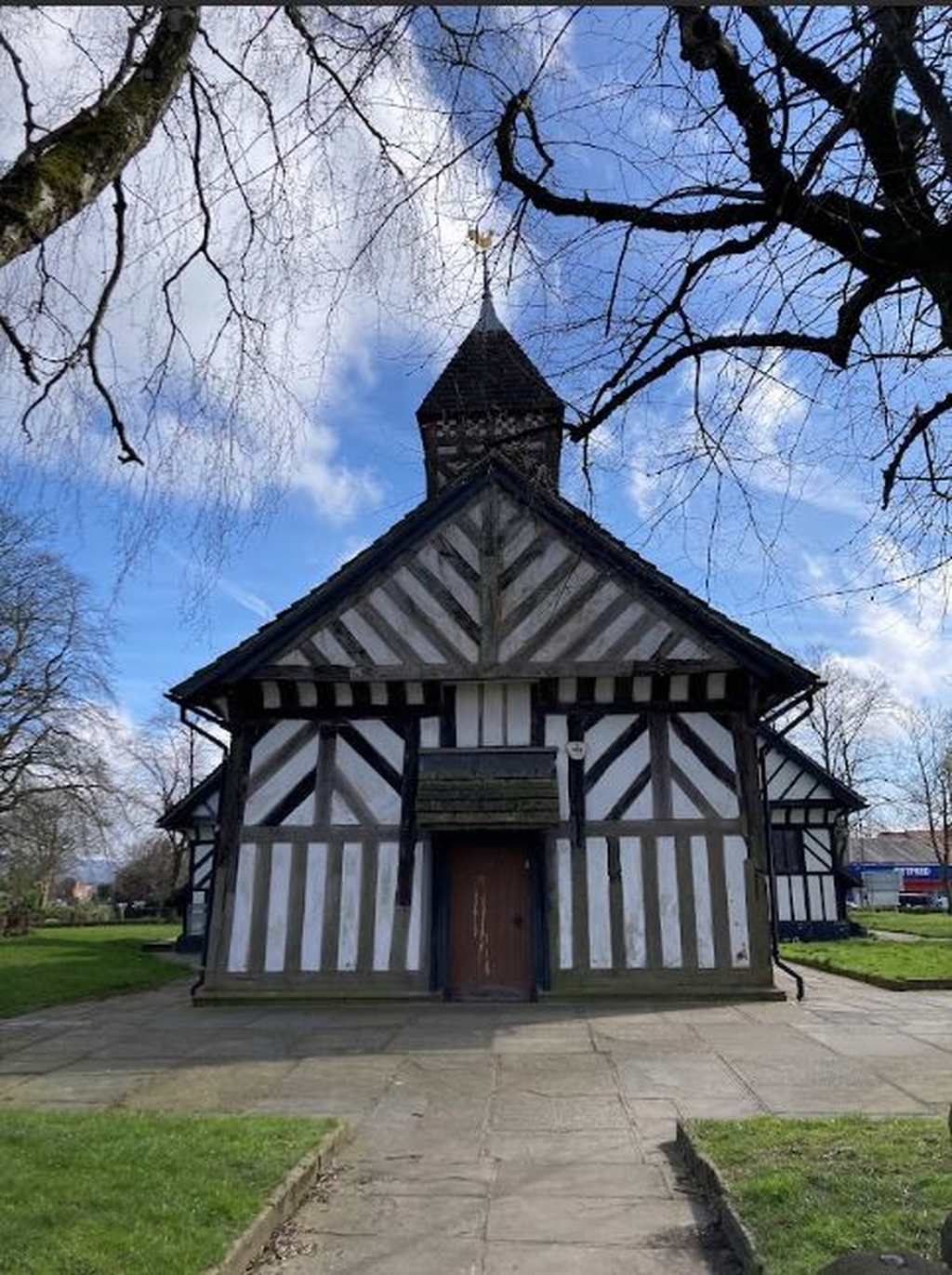
After standing for nearly 500 years from the Tudors to present day, this church remains as a symbol of the religious life of Denton, physically linking with the town's medieval past and local families who founded the chapel.
©Photo Bob Alston 2010
It is known locally as
Th'owd Peg, because of the wooden pegs used to join the timbers
The black and white church for obvious reasons
There are extensive parish records available for those interested in genealogy further information is available from UK and Ireland Genealogy
Historical Development
St Lawrence's Church, Denton is a timber-framed building dating from 1531 at the most conservative estimate. Only 29 of this type of common medieval building remain in England and Wales. These are scattered from Kent in the South East to Lancashire in the North West. Originally the timber-framed structure was neither a parish church nor dedicated to St. Lawrence. It began as a chapel of ease (a type of half-way house) for the medieval manor of Denton within the Parish of Manchester, dedicated to St. James. It became a parish church under the name St. Lawrence in 1839. Story of St. Lawrence can be read by clicking this link.
When the chapel was built, its original benefactors, the Hollands and Hydes, were staunch Roman Catholics. It stood firm also through the upheavals of the Puritan Era, under the leadership of the much-persecuted Puritan leader, John Angier. A later notable pastor, William Parr Greswell, began the process of reshaping the chapel along more conventional liturgical lines, a process later accelerated in the era of the Tractarian Movement.
The Church was dedicated to St. Lawrence by Parr Greswell as a result of the discovery within the structure of fragments of glass depicting the martyrdom of St. Lawrence. These fragments are now incorporated into a window on the south side of the sanctuary.
Geography
The Church stands on the busy Ashton to Stockport Rd, and so is seen by many travellers. It is about a quarter of a mile from the Town Centre of Denton, at the centre of the parish of St. Lawrence.
Environmental Significance
The Church stands in one of the few open green spaces in the urban environments of Denton. The trees in the churchyard have Preservation Orders on them. Both the Parochial Church Council and the Local Authority are in total agreement that the openness of the site should not only be preserved but enhanced for the sake of the local community, and future generations.
Features of interest outside the Church
Pegs, not nails
The beams are held together with wooden pegs. These pegs gave the Church its original nickname 'Th'owd Peg'. In the restoration work carried out in 1995, traditional methods were followed, and new pegs put in to replace the old.
Mounting Block
In the south part of the churchyard, near the Memorial garden is a stone step or Mounting block, used to help people get on and off their horses as they arrived for worship. It probably stood somewhere near the Lych Gate.
©Photo Bob Alston 2010
The Graveyard
This was grassed over in 1965 when the former Denton Council took it over under the Open Spaces Act, and, in accordance with that Act the gravestone were either removed, covered over or broken up. A few gravestones remain, though probably not in their original locations. The most notable of these is that of Colonel Robert Dukinfield, (an updated version of an older one), a prominent combatant in the English Civil War, and buried somewhere in the graveyard.
Lych Gate (from old Saxon meaning of death)
When people were brought to the Church for funerals only the coffins of those who could afford it were taken in Church. The coffins of poorer people rested under the Lych Gate until burial after a service.
Nowadays it is very popular to have wedding photographs taken there.
©Photo Bob Alston 2010
Blue Plaques
Two blue plaques stand on the East side of the building, one as a general reference to the Church, the other a memorial to the Rev John Angier, minister of the Church during the upheavals in the Puritan Era of the seventeenth Century.
©Photo Bob Alston 2010
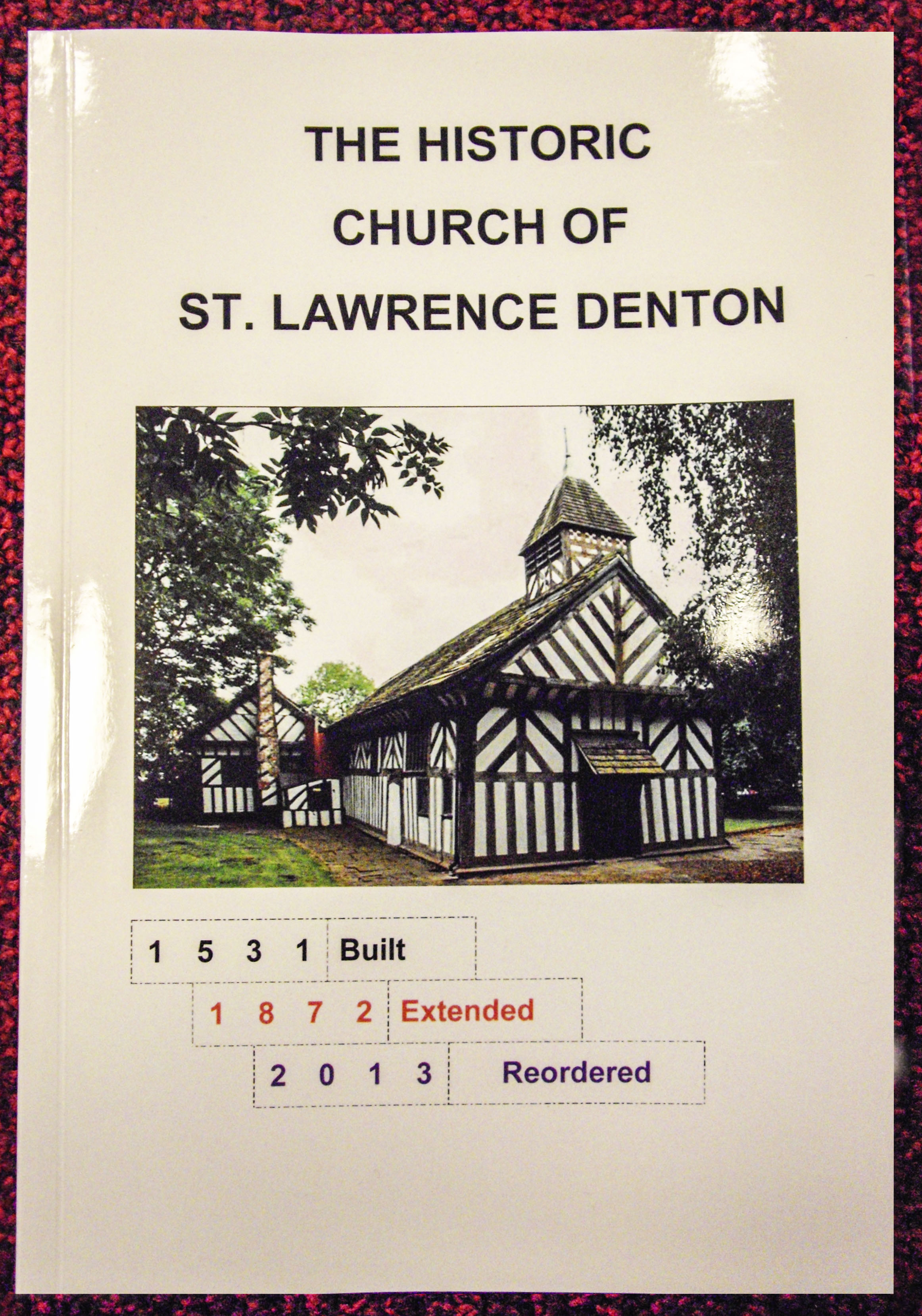
History of St Lawrence Church Booklets are on sale from Church (£3 each)