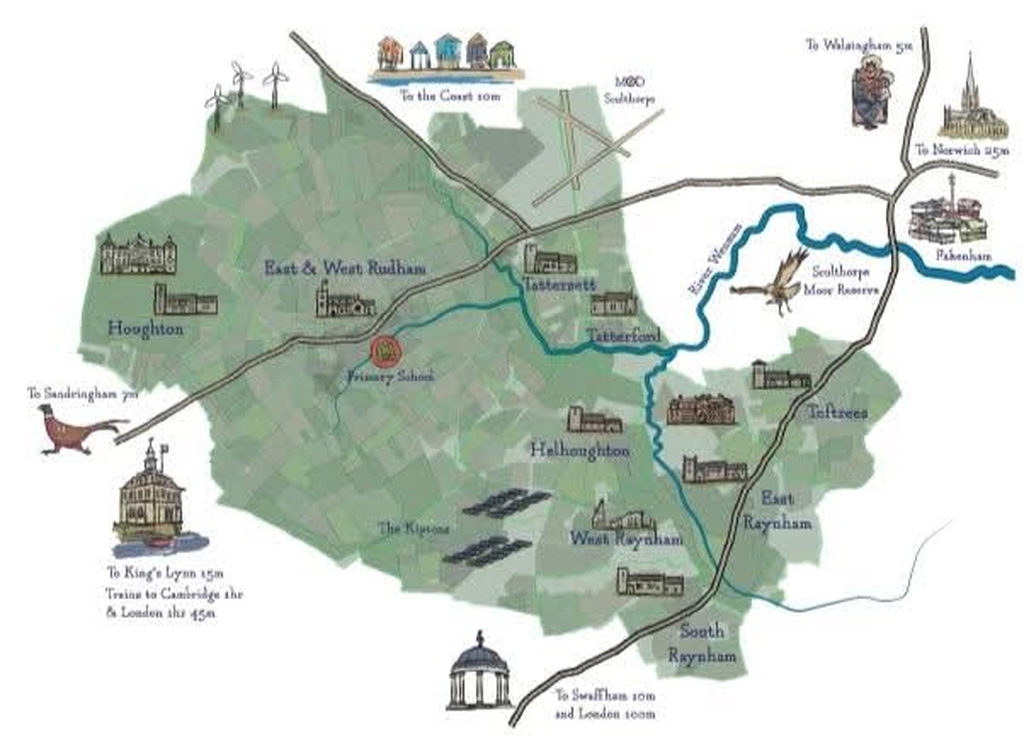

Related Churches
-
1
East Rudham: St Mary
Welcome to St Mary’s, East Rudham
Standing proudly beside the main road through the village, St Mary’s is a light-filled and gracious church that has long been part of the everyday life of East Rudham. Though rebuilt in the late 19th century after the collapse of its medieval tower, the church carefully preserves its earlier story, reusing materials from the original building and retaining features such as the south doorway and carved bosses.
Inside, the church is open, spacious, and bright, blessed with clear glass throughout and a wide chancel filled with light from the east window. Touches of colour, especially in the transepts, bring warmth and richness to the space. In the north aisle, fragments of a 15th-century alabaster reredos remind us of the deep roots of faith here, including a particularly moving Crucifixion scene that continues to speak quietly of sacrifice and hope.
St Mary’s is a place shaped by renewal and resilience, offering space for worship, reflection, and stillness amid the movement of daily life.
Whoever you are, and whatever brings you to St Mary’s, East Rudham, you are always welcome.
-
2
Tattersett: All Saints & St Andrew
Welcome to All Saints, Tattersett
Nestled in the quiet fields of Norfolk, All Saints is a small, historic church that has welcomed generations of worshippers for centuries. Though reached by a peaceful half-mile track across the countryside, it has always been at the heart of our local community, including the nearby village of Tattersett.
This little church may be remote, but it is open to all. Visitors often find a sense of calm and stillness here, a place to pause, reflect, and feel connected. Inside, the muted colours and simple furnishings invite quiet contemplation, while subtle hints of its long history—like the 15th-century font and traces of ancient wall paintings—remind us of the generations who have prayed here before.
Whether you are exploring faith, seeking a moment of peace, or simply curious about the building and its story, you are warmly welcome at All Saints.
Whoever you are, and whatever brings you here, you are always welcome at All Saints, Tattersett.
-
3
East Raynham: St Mary
Welcome to St Mary’s, East Raynham
Set within the gently rolling landscape south of Fakenham, where fields and small copses form a quiet patchwork of rural Norfolk, St Mary’s, East Raynham, sits beside Raynham Hall, enveloped in the rich parkland of the Raynham estate. The Hall has long been the home of the Townshend family, and the church stands as a gracious and enduring part of that historic setting.
From the outside, the church may appear modest and restrained, but stepping inside reveals a pleasant and unexpected surprise. This is a quiet, calm, and seemly place, marked by a gentle dignity rather than architectural display.
The nave is wide and open, well lit and neatly furnished, offering a space that feels both welcoming and serene. There is none of the dramatic flourish found in some broadly contemporary rebuildings elsewhere in Norfolk; instead, St Mary’s invites stillness and attentiveness. The east windows of the aisles contain glass from the 1950s: in one, the Risen Christ on the Road to Emmaus with figures intended as Saints James and John; in the other, Christ flanked by St Margaret and the Blessed Virgin — images that speak quietly of faith, encounter, and hope.
Rooted in its estate and village setting, yet open to all, St Mary’s offers a peaceful and contemplative place for worship, prayer, and reflection, valued by those who come seeking beauty, calm, and a sense of continuity.
Whoever you are, and whatever brings you to St Mary’s, East Raynham, you are always welcome.
-
4
Houghton-next-Harpley: St Martin
Welcome to St Martin’s, Houghton
Set within the beautiful parkland of the Houghton estate, St Martin’s is a small historic church that offers a peaceful and contemplative space, much appreciated by visitors seeking a quiet moment away from the bustle of modern life. Though its 19th-century flintwork gives it a distinctive appearance, the church itself is much older, with a rich history reflected in features such as the 18th-century font, medieval effigy, and 17th-century chancel benches.
The parish is centered around the Houghton estate, but everyone is warmly welcome to join our monthly Book of Common Prayer communion service, and to enjoy the tranquillity, beauty, and sense of community that St Martin’s offers.
Whoever you are, and whatever brings you to St Martin’s, Houghton, you are always welcome.
-
5
Tatterford: St Margaret
Welcome to St Margaret’s
Here, in the remote north of Norfolk, St Margaret’s stands within an intensely rural parish not far from the Raynham estate. Built in 1862 by William Lightly as a chapel of ease to All Saints, Tattersett — itself among the most remote of Norfolk’s parish churches — St Margaret’s occupies a striking and memorable setting. Approached by a steep path, the tall, narrow chancel rises like a sentinel, drawing the eye upwards as you climb towards the great crucifix.
As you come out into the open space to the north of the church, the building reveals quite how unusual it is. The narrow lancet windows give it a fortress-like character, while the north doorway sits within a curious pseudo-porch, surmounted by a ridged roof that hints at ambitions once imagined but never completed. It is a church that feels purposeful, intentional, and quietly dramatic.
Stepping inside, you enter a deeply devotional interior. This was once almost a shrine in its own right, and much of that atmosphere remains. Statues of St George and St Margaret still stand on their brackets, alongside a most unusual image of the young Christ teaching in the Temple. Together they give the space a strong sense of prayer, teaching, and faithful witness.
Perhaps the most extraordinary survival is now set aside, resting on the roof of the internal vestry: a vividly painted pulpit with open arcading and images of angels and saints, more reminiscent of a theatrical set than a conventional furnishing. By contrast, the massive bowl of the Norman-style font speaks with a quieter confidence. Plain for its period, yet bearing an ornate inscription — Except a man be born of water and the Spirit — it anchors the church firmly in the sacramental life of faith.
This intensely devotional space is once again in regular use, and there is another compelling reason to visit. The east window, designed by Moira Forsyth in 1947 and depicting Christ the High Priest, is widely regarded as one of the finest windows of its decade anywhere in the county.
Rooted in its rural setting, shaped by devotion, and open once more to worship and prayer, St Margaret’s offers a place of stillness, beauty, and encounter.
Whoever you are, and whatever brings you to St Margaret’s, you are always welcome.
-
6
West Raynham: St Margaret
St Margaret's, West Raynham is a place where history, community care, and the beauty of the natural world come together. St Margaret’s was first built in the 1320s, a fine example of the medieval churches that once served villages across Norfolk. Over the centuries it was altered and reshaped, witnessing the ebb and flow of life in this rural parish. By the early 18th century, regular worship here had ceased and the parish was united with East Raynham’s, leaving St Margaret’s to fall gradually into ruin.
For many years the church remained hidden beneath ivy and dense vegetation, its walls a quiet reminder of what had once been. Thanks to the tireless work of local volunteers and the St Margaret’s in Ruins Conservation Trust, the site has now been carefully cleared and cared for, revealing the true grace of its ancient stones.
Today, St Margaret’s stands as a treasured historic ruin and a place of continuing worship — a peaceful sanctuary where wildflowers and wildlife thrive alongside echoes of the past. Birds, insects and meadow plants now share this space with visitors, drawing together heritage and nature in a beautiful balance.
Although the roofless walls can seem quiet, the presence of a simple modern altar recalls the church’s ancient purpose and ensures that it is a place of worship: a place of prayer, community and welcome. In recent years, services such as Easter communions, summer gatherings, carol concerts and special blessings have been held here under the open sky.
The Trust continues to work with the community to conserve the ruins and enhance this special place. Plans include creating a Centre of Excellence for heritage and environmental skills, so that this unique site can inspire not only appreciation but active learning in conservation for generations to come.
Whether you come here to pray, to reflect, to enjoy the natural world, or simply to explore the quiet beauty of history, may your time among these stones be one of peace, wonder and connection to the long story of this place.
-
7
Helhoughton: All Saints
Welcome to All Saints, Helhoughton
We are delighted to welcome you to St Mary’s, a peaceful country church serving the heart of our village and its surrounding communities. Set on the edge of the beautiful Raynham estate, our church has stood for centuries as a place of prayer, hospitality, and hope.
All Saints has a long and fascinating history, but more importantly, it is a living church where people of all backgrounds and ages are warmly received. Whether you are visiting, returning after some time away, exploring faith, or looking for a friendly community to be part of, you are very welcome here.
Our building may be ancient, but our welcome is wholehearted and open. We hope you will find here a sense of stillness, beauty, and belonging.
If you would like to know more about our services or life in the Coxford Group of Churches, please do speak to someone or explore further—we would be delighted to help.
Whoever you are, and whatever has brought you here today, you are warmly welcomed at All Saints, Helhoughton.
Location information
If you've spotted any issues in the contact information, please contact the church by selecting the following link.
Report an IssueProof of charity status
Most churches are “Excepted Charities” and are therefore not registered with the Charity Commission. You can download a PDF that includes your church name, address and church code. This PDF, which is an extract from the Church of England’s database of churches, can serve as a certificate for churches requiring proof of their charity status when registering for online and card-based giving. Click on the download button below and log into your AChurchNearYou.com account. Once logged in, click on the download button and the certificate will be downloaded straight to your device. If you do not have an AChurchNearYou.com account, you can register here.