
Church guide
Welcome to St. Mary’s church
We hope you enjoy looking around this lovely and much loved historic building. Spend as long as you want and enjoy the peace.
The entrance
You have come through 3 sets of doors: the “bird” doors stop birds flying in – it’s not easy for them to get out again, the main wooden doors keep the building secure and the glass doors are the most recent addition to the building, replacing wooden Victorian doors which, while functional, did not enhance the beauty of the church.
History
There was probably a church here in Saxon times. A Saxon stone found in the nineteenth century can be seen in the base of the churchyard wall opposite the old rectory. The girls of the village used to “christen” their dolls there!
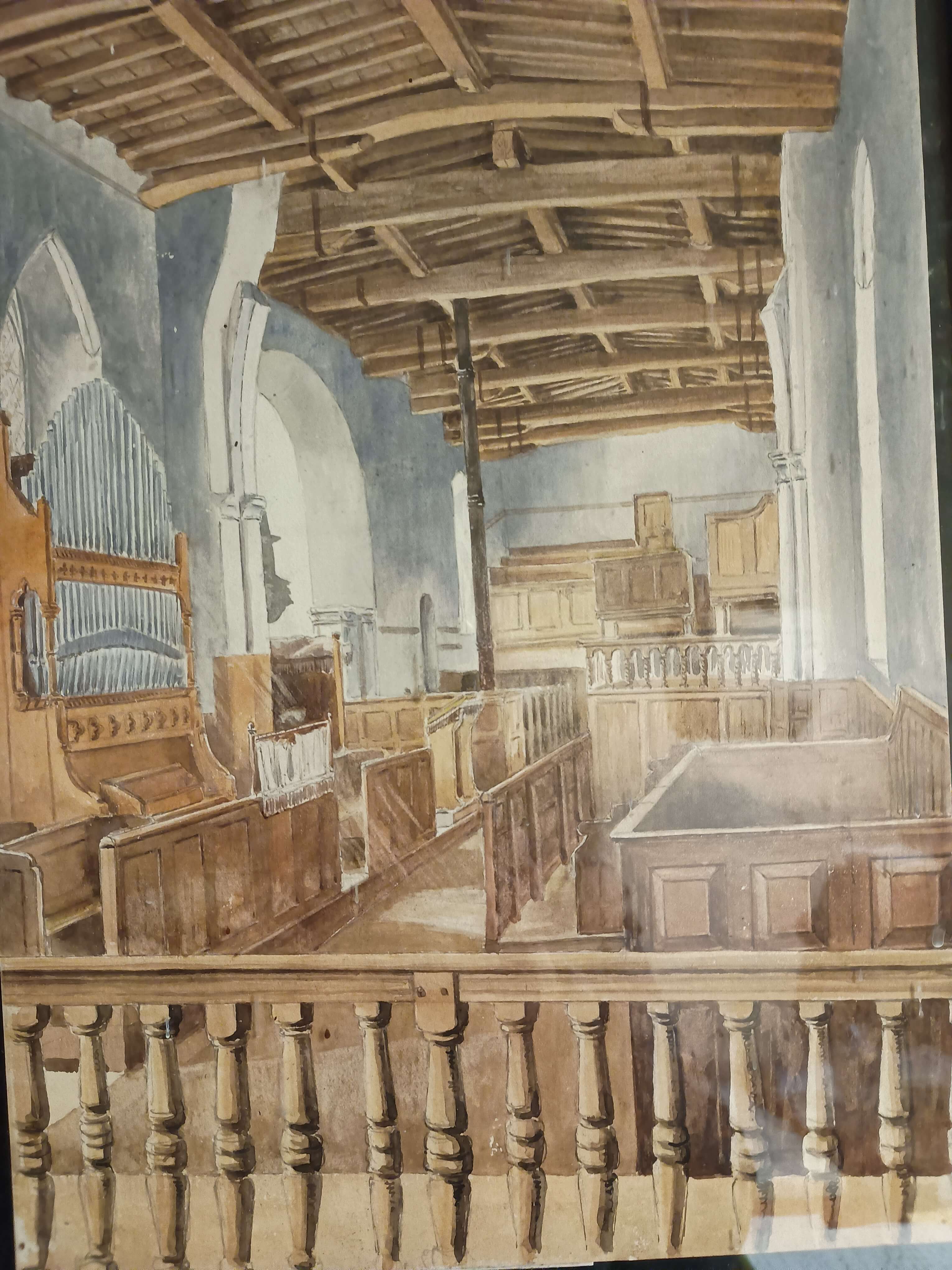
The church has been constantly altered, changed and improved over the centuries that it has been here. Major work was carried out in the 1870s. The church interior is almost unrecognisable in a painting done before these works were carried out. You can see the painting at the end of this guide. The roofs have been lowered (1629) and raised (1873). The big arches have been broken and restored. An organ was installed and then moved. Windows have been replaced and a gallery removed. It would be difficult to get permission for this sort of work now, and exorbitantly expensive. However, more recently, besides the glass doors, new lighting was put in, a sound system installed and heating added as well as a TV screen to help with our regular worship. The funding for these improvements has come from legacies as well as some grants.
The font
On your left is the font. It is traditional to have the font inside the main door as it represents entrance to the Christian life. The current one dates from the 1800s and the one it replaced, which is understood to be Saxon, is now outside near the church door. Look out for it as you leave. It is grade 2 listed (as is the church).
The war memorial
Our war memorial is inside the church – very welcome on a damp Remembrance Sunday – and lists the names of all those from the parish who died in the two world wars. A list of all those who went to fight hangs in the porch. If you are interested in any of those listed on the war memorial do leave us a note or contact us via A Church Near You as research has been done into all of them.
The tower
As you look to you left you will see the door into the tower space. Above it is the coat of arms of Dr Peter Samwaies, once rector of this parish. He endowed the school and almshouses and owned a lot of land locally. The tower was built in 1812 on the foundations of a much earlier tower. We have 6 bells and they are rung regularly. If you are local and are interested, you could join the team. The bells date from 1776, 1873 and 1901.
The pulpit
If you walk up towards the altar at the eastern end of the church, you will find yourself near the richly carved oak pulpit. This was made in 1865 for Ripon cathedral and was given to St Mary’s in 1948.
The Norton chapel
Extending from the church is the south transept, commonly known as the Norton chapel as members of the Norton family, as well as the Grahams of Norton Conyers, are remembered there and some are buried in a vault below. This was built soon after the chancel in the early 14th century. Several monuments, tablets and brass shields can be seen here. Beneath the south window is a fine arched tomb-recess, surmounted by a lofty pediment now sadly mutilated. The grave cover in the recess was found in the churchyard and dates to the early 14th century.
The windows
While you’re in the Norton chapel, take a look at the windows. The original five light south window, the large one, has disappeared and was replaced in by a more recent one in memory of Lady Graham who died in 1917. However, there are two original windows, one in the east wall and one in the west. An heraldic shield of 14 quarterings, identified as that of Sir Henry Fitzhugh, Lord of the Manor of Wath (died 1472), impaling the arms of his wife, Alice Neville, sister of Richard, Earl of Warwick (the King Maker) can be seen in the west window and at the top of the east window is a small piece of glass portraying Christ on the cross. These are among the few pieces of ancient glass remaining in the church.
The chancel
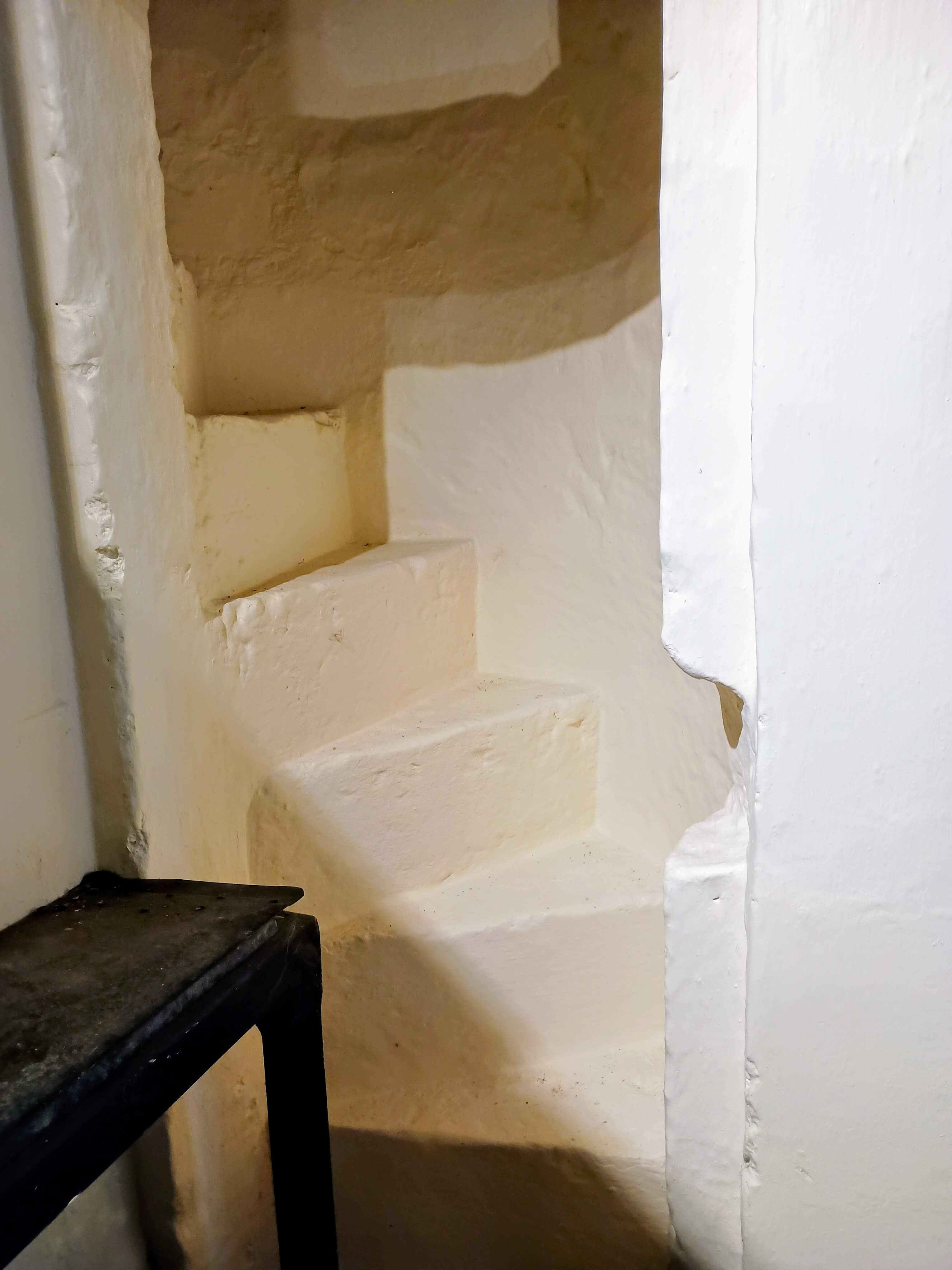
If you return to the main body of the church and walk up through the chancel you will see the organ on the left. A small plaque remembers Kathleen Akers who played for the church for many years. Another commemorates the restoration of the organ and Sir Richard Graham’s 22 years as churchwarden. Ahead is the east window which as you would expect highlights parts of the life of St Mary. The vestry is to the left of the altar and cannot be seen. The original door into it is no longer used but can be seen. Further east on the same wall is a ‘squint’ (or angled) window enabling the priest to see the altar. The vestry was built in the 15th century with a room above it approached by a spiral stone staircase, the lower steps of which can still be seen in the vestry. You can see a photo at the end of this guide. If you have time, do have a look from the outside where you can see the window into the room. A carved mid-14th century chest is currently kept in the vestry.
The remaining windows
There are three windows in the north wall of the nave; the first is partly renewed and the others are entirely modern, as is the south doorway. To the west of this is a window similar to those opposite but all old except the mullion.
The churchyard
Before you leave us, please consider making a donation to the upkeep of the church and of the churchyard. (There is a card machine below the war memorial.) We try hard to keep the churchyard looking attractive although it is an expensive business and we are not a large congregation. If you are tracing the graves of your ancestors, we hope you find them. While you are outside remember to look for the old font, the Saxon stone in the churchyard wall and the window to the priest’s room. There are also two table tombs in the churchyard that are listed and an 18th century pillar sundial. Both entrance gateways are also listed.