


Dear friends,
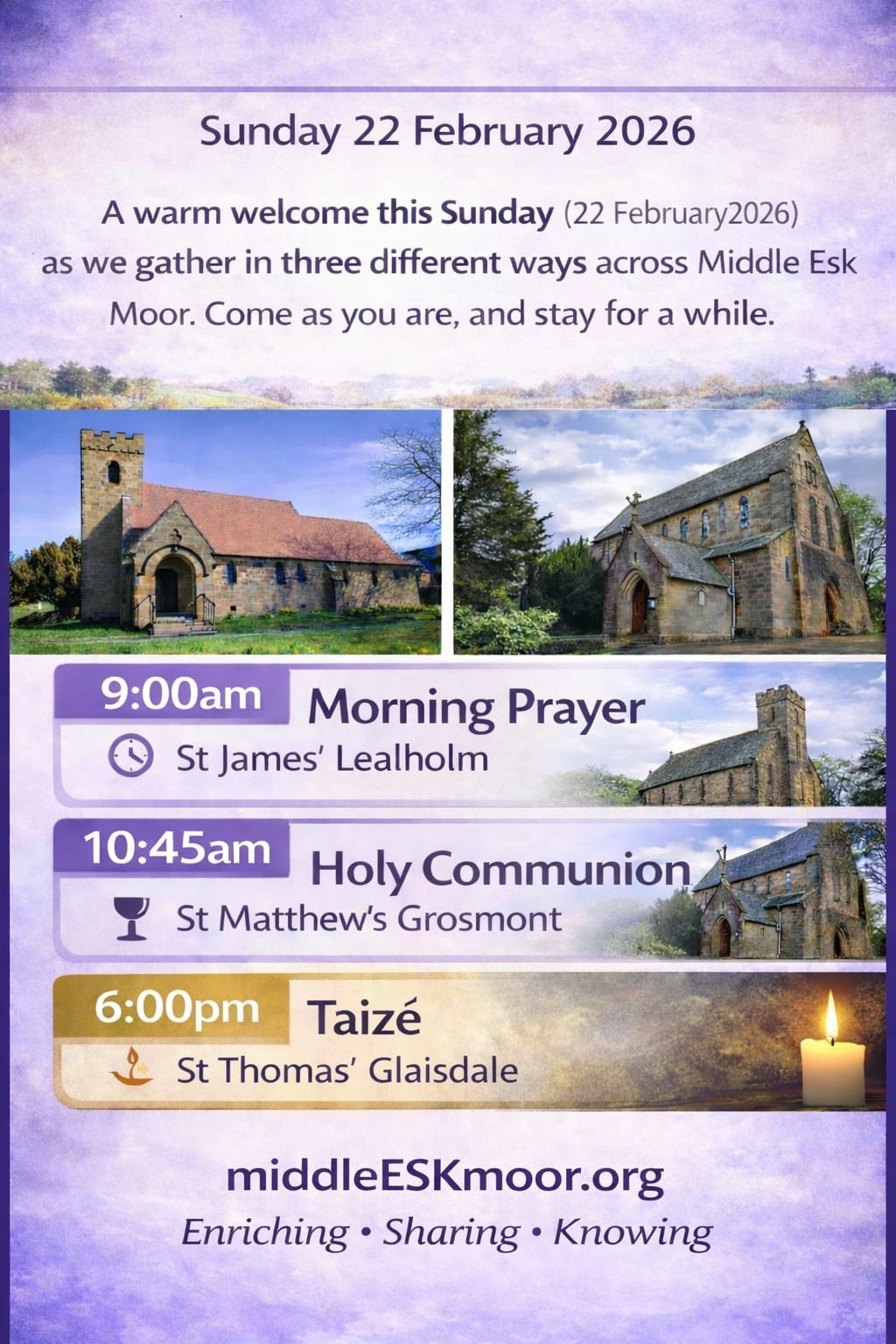
Just a Round Robin with a copy of my sermon from Ash Wednesday and to say that you're very welcome, if you’re able, to join us tomorrow at Lealholm (9 am), Grosmont (10:45 am) or Glaisdale (6 pm).
On Easter Saturday, 4th April, Bishop Barry will be joining us at a special Easter Vigil at 8 pm at St Hilda’s in Whitby where there will be the opportunity to Confirm or Re-Confirm our faith in Jesus. If you haven’t been Confirmed and would like to find out more, we are doing some preparation during Lent. Just reply to this message and I will send you further information. If you were Confirmed a while ago and would like to rediscover your faith more deeply during Lent, you would be most welcome to explore with us too. Again, just get in touch.
With love and blessings,
Reverend Anthony
Ash Wednesday Sermon
The journey into Lent begins
Preacher: Reverend Anthony
Psalm 51
Have mercy on me, O God, in your great goodness; according to the abundance of your compassion blot out my offences.
Wash me thoroughly from my wickedness and cleanse me from my sin.
For I acknowledge my faults and my sin is ever before me.
Against you only have I sinned and done what is evil in your sight,
So that you are justified in your sentence and righteous in your judgement.
I have been wicked even from my birth, a sinner when my mother conceived me.
Behold, you desire truth deep within me and shall make me understand wisdom in the depths of my heart.
Purge me with hyssop and I shall be clean; wash me and I shall be whiter than snow.
Make me hear of joy and gladness, that the bones you have broken may rejoice.
Turn your face from my sins and blot out all my misdeeds.
Make me a clean heart, O God, and renew a right spirit within me.
Cast me not away from your presence and take not your holy spirit from me.
Give me again the joy of your salvation and sustain me with your gracious spirit;
Then shall I teach your ways to the wicked and sinners shall return to you.
Deliver me from my guilt, O God, the God of my salvation, and my tongue shall sing of your righteousness.
O Lord, open my lips and my mouth shall proclaim your praise.
For you desire no sacrifice, else I would give it; you take no delight in burnt offerings.
The sacrifice of God is a broken spirit; a broken and contrite heart, O God, you will not despise.
2 Corinthians 5.20b–6.10
So we are ambassadors for Christ, since God is making his appeal through us; we entreat you on behalf of Christ, be reconciled to God. For our sake he made him to be sin who knew no sin, so that in him we might become the righteousness of God.
As we work together with him, we urge you also not to accept the grace of God in vain. For he says,
‘At an acceptable time I have listened to you,
and on a day of salvation I have helped you.’
See, now is the acceptable time; see, now is the day of salvation!
We are putting no obstacle in anyone’s way, so that no fault may be found with our ministry, but as servants of God we have commended ourselves in every way: through great endurance, in afflictions, hardships, calamities, beatings, imprisonments, riots, labours, sleepless nights, hunger; by purity, knowledge, patience, kindness, holiness of spirit, genuine love, truthful speech, and the power of God; with the weapons of righteousness for the right hand and for the left; in honour and dishonour, in ill repute and good repute. We are treated as impostors, and yet are true; as unknown, and yet are well known; as dying, and see—we are alive; as punished, and yet not killed; as sorrowful, yet always rejoicing; as poor, yet making many rich; as having nothing, and yet possessing everything.
John 8.1–11
After Jesus went to the Mount of Olives, early in the morning he came again to the temple. All the people came to him and he sat down and began to teach them.
The scribes and the Pharisees brought a woman who had been caught in adultery; and making her stand before all of them, they said to him, ‘Teacher, this woman was caught in the very act of committing adultery. Now in the law Moses commanded us to stone such women. Now what do you say?’ They said this to test him, so that they might have some charge to bring against him.
Jesus bent down and wrote with his finger on the ground. When they kept on questioning him, he straightened up and said to them, ‘Let anyone among you who is without sin be the first to throw a stone at her.’ And once again he bent down and wrote on the ground.
When they heard it, they went away, one by one, beginning with the elders; and Jesus was left alone with the woman standing before him. Jesus straightened up and said to her, ‘Woman, where are they? Has no one condemned you?’ She said, ‘No one, sir.’
And Jesus said, ‘Neither do I condemn you. Go your way, and from now on do not sin again.’
Sermon
May the words of my mouth and the meditations of our hearts together be acceptable in your sight, O Lord, our rock, and redeemer. Amen.
Let’s begin with a simple, quiet prayer. Just for a few seconds: Lord, show each of us what you want to speak to us about this afternoon. Amen.
In our Gospel reading, everything begins in a very ordinary way. Early in the morning Jesus comes back to the temple. People gather. He sits down and begins to teach. It’s calm. It’s settled. It’s a place where you might expect wisdom, not spectacle.
And then the scribes and the Pharisees turn it into a drama. They bring a woman caught in adultery, and they make her stand in front of everyone. They don’t bring her because they care about holiness. John tells us they are testing Jesus, trying to trap him, trying to manufacture a charge against him. She becomes a prop. Her shame becomes their weapon.
So let me ask, gently, as we sit with this story this afternoon: where do you find yourself in it?
In the crowd, watching?
Carrying a stone?
Feeling exposed?
Standing close to Jesus?
That question matters, because the story isn’t only about “them”. It is about the human heart, and the ways we handle guilt, and judgement, and mercy.
Then comes the moment I want to sit with on this Ash Wednesday. Under pressure, under interrogation, Jesus does something unusual, something quite counter-cultural.
He bends down and writes with his finger on the ground. What was Jesus writing in the sand?
John doesn’t tell us, and perhaps that’s deliberate. Perhaps the Holy Spirit wants us to ponder it, rather than pin it down. So take a moment. What do you think Jesus might have been writing?
Maybe he wrote a commandment, to remind them that the law was given to lead people into life, not to provide an excuse for cruelty.
Maybe he wrote their sins, not to humiliate them, but to get them to think more deeply.
Maybe he wrote her name, as if to say: this is a person, not a case, not a cautionary tale.
Maybe he wrote a single word: mercy.
And if that is what Jesus might have written then, what word might Jesus write for you this afternoon? Not about somebody else. About you. If you can, hold a word or a phrase in your mind for a moment, and don’t rush past it.
Let’s pause for a moment.
There’s something else that matters here. Jesus doesn’t respond to the shouting with more shouting. He refuses the rush to judgement. He slows the whole moment down. He makes space.
What helps you slow down enough to be honest with God?
Some people slow down in silence. Some by walking. Some by reading Scripture slowly. Some by lighting a candle and letting the day settle. Ash Wednesday itself is a kind of slowing down. It is the Church saying: stop. Breathe. Tell the truth. Return to God.
When they keep questioning him, Jesus straightens up and says: “Let anyone among you who is without sin be the first to throw a stone.”
That line has been used so often that it can sound like a slogan. But in the moment it’s a turning point. It takes the focus off the woman for a second, and places it back where it belongs: on the hearts of those who are so sure they’re right.
Grasp hold of an imaginary stone in your hand. Imagine yourself holding on to it tightly. If we’re honest, stones are not only for other people. Church folk can get very skilled at carrying polished stones. Not always obvious, sometimes carried quietly in our pockets.
What stones are easy to carry?
The stone of judgement. The stone of old resentment. The stone of rehearsing someone else’s failures. The stone of being sharper with ourselves than we would ever be with anyone else.
If you’re willing, unclench your hand for a moment. Let that simple movement be a prayer: Lord, I’m putting the stone down.
Then Jesus bends down again, and writes again on the ground. He stays low. He stays close to the dust. He doesn’t stand over anyone. He doesn’t loom. He doesn’t humiliate. He stays near the place where human beings actually live.
That is Ash Wednesday, isn’t it? Dust and mercy in the same place?
One by one, they go away. Beginning with the elders. And then it’s just Jesus and the woman, standing there. And Jesus asks her: “Woman, where are they? Has no one condemned you?”
She says: “No one, sir.”
And Jesus says: “Neither do I condemn you. Go your way, and from now on do not sin again.”
Here is the heart of the Gospel in three short sentences. Jesus doesn’t deny sin. He doesn’t call wrong “right”. But he refuses condemnation. He offers mercy, and then he opens a new future.
So let me ask two questions, and let them land where they need to land.
Where do you most need to hear Jesus say: “Neither do I condemn you”?
And what might “from now on” look like for you as Lent begins? Not a grand performance. Not a dramatic reinvention. Just one small step. One honest prayer. One habit to loosen. One apology to make. One act of kindness. One turning back towards God.
This is also why Lent is such a fitting time for anyone exploring baptism or confirmation. It’s not about being sorted. It is about belonging to Jesus, and letting his mercy and his truth shape our life.
A question for all of us here today: if you were preparing for confirmation, what question would you want to bring into that preparation?
You don’t need to say it aloud. Just name it to God.
Lent is a journey, a pilgrimage over the next 40 days. On Holy Saturday night we’ll gather for the Easter Vigil at St Hilda’s in Whitby, where there will be confirmations from across the deanery. The Church tells the story from darkness to light, and we watch God give new beginnings.
And on Easter Sunday, Bishop Barry will be with us in Lealholm. A reminder that we’re part of something bigger, and God is still raising people to new life.
So between this afternoon’s ashes and Easter’s light, what do you hope God might change in you?
We don’t know what Jesus wrote in the sand. But we do know what he does. He stops the cruelty. He tells the truth. He gives mercy. He opens a future.
As the ash is marked this afternoon, let it be our prayer: Lord Jesus, write mercy in us. Write truth in us. Write a new beginning in each of us.
Amen.