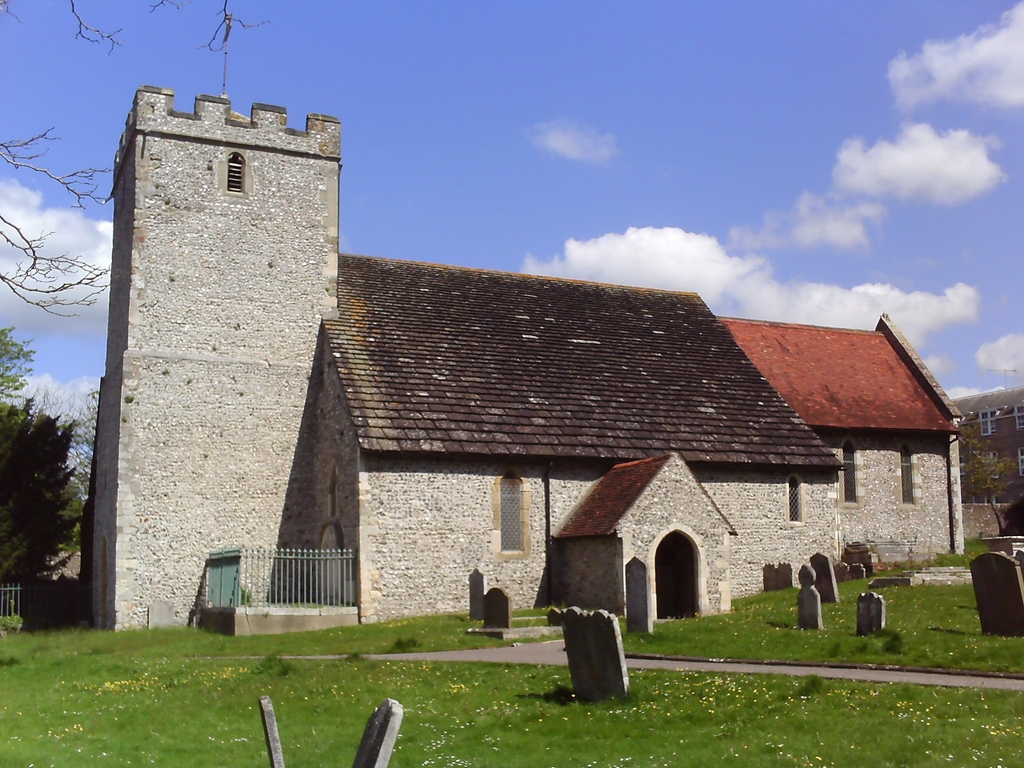
The chapel was erected in 1869 on the north-west side of the church. It could not be more different from the plain interior of the church because the chapel is a riot of carved oak, marble, beautiful floor tiles and stained glass windows. The Brighton Gazette (13 March 1873) had this to say ‘Everything connected with the chapel is of a finished and elaborate character, and bespeaks great care and taste, which have been expended upon it. In the centre is the tomb having the armorial bearings of the family sculptured on the front in stone; the base consisting of a fine piece of polished marble, perfectly black, and the top also of black marble, slightly veined. The floor is composed of mosaic work and coloured tiles’. In 1965 Nairn & Pevsner in their Buildings of England ; Sussex remarked that the chapel was ‘far more ornate than anything else in the church, and successful out and in. Heavy grief, like a mausoleum’.
Miss Brackenbury never lived at Portslade herself, but was friends with the Frederick G. Holbrooke, the vicar of St Nicolas Church. She lived in some splendour in Adelaide Crsecent,
Hannah Brackenbury commissioned and paid for the chapel but it is something of a mystery as to why Portslade was the chosen spot. The Brackenburys originated in Yorkshire but moved south to benefit her brother’s health. Hannah was unmarried and lived with her widower brother James Blackledge Brackenbury at Hove. But he died in 1844 and was buried in St Nicolas Churchyard. Her other brother Ralph died in 1846 and Harriette Mary, James’s only child, died in 1861. This meant that Hannah Brackenbury became the last survivor of her family and inherited a wealth so great that she was able to give away £100,000 during her lifetime not to mention the many bequests from her will. Like many people today Hannah was interested in family history and believed she was descended from an ancient family with links to the Norman Conquest. In fact there is no concrete proof but she was rich enough to indulge her fantasies and create a magnificent family mausoleum to state her belief. An example of family pride is the small window in the north wall of the chapel depicting a black lion under an oak tree (the crest of Sir Perse de Brackenbury) and the family motto Sans recueller jamais (Without ever drawing back). This motto is also to be found at Balliol College, Oxford of which Hannah was a benefactress.
As to the architect responsible for the chapel, it is very odd that his name is not known despite research in various archives. All that can be said is that he was most probably Edmund Evan Scott since he was responsible for the Brackenbury Schools in Portslade, which opened in 1872 and paid for by Hannah. Scott also designed St Andrew’s Church, Portslade in 1864 and the chapels in Portslade Cemetery. His most famous work was St Bartholomew’s Church, Brighton, opened in 1874.
Hannah Brackenbury died on 28th February 1873 and in 1874 a trust fund was established to look after the upkeep of the chapel with ‘£200 consolidated’. By 1901 the balance stood at £91 but by 1946 all that was left in the kitty was £33-17-4d. The final payment was made in February 1953 when £8 was paid for shares in the East India Railway Company. Incidentally, it was judicious investment in early railway developments that earned the Brackenburys their vast wealth.
Today the chapel represents a major problem. The stonework around the windows is crumbling and keeping the damp out and reducing the condensation inside has always been a worry. To put it bluntly the chapel is of absolutely no use in the modern running of the church. It is interesting because it is beautiful and of historical importance. But where would the money for a proper restoration come from? In 1998 the cost of repairs was put at £60,000 and an application for Lottery funding was unsuccessful. Neither was Balliol College interested in helping out although Hannah donated at least £20,000 to the college for the construction of buildings on the south side of the quadrangle as well as endowing some scholarships, which still exist to this day.
Copyright © J.Middleton 2016