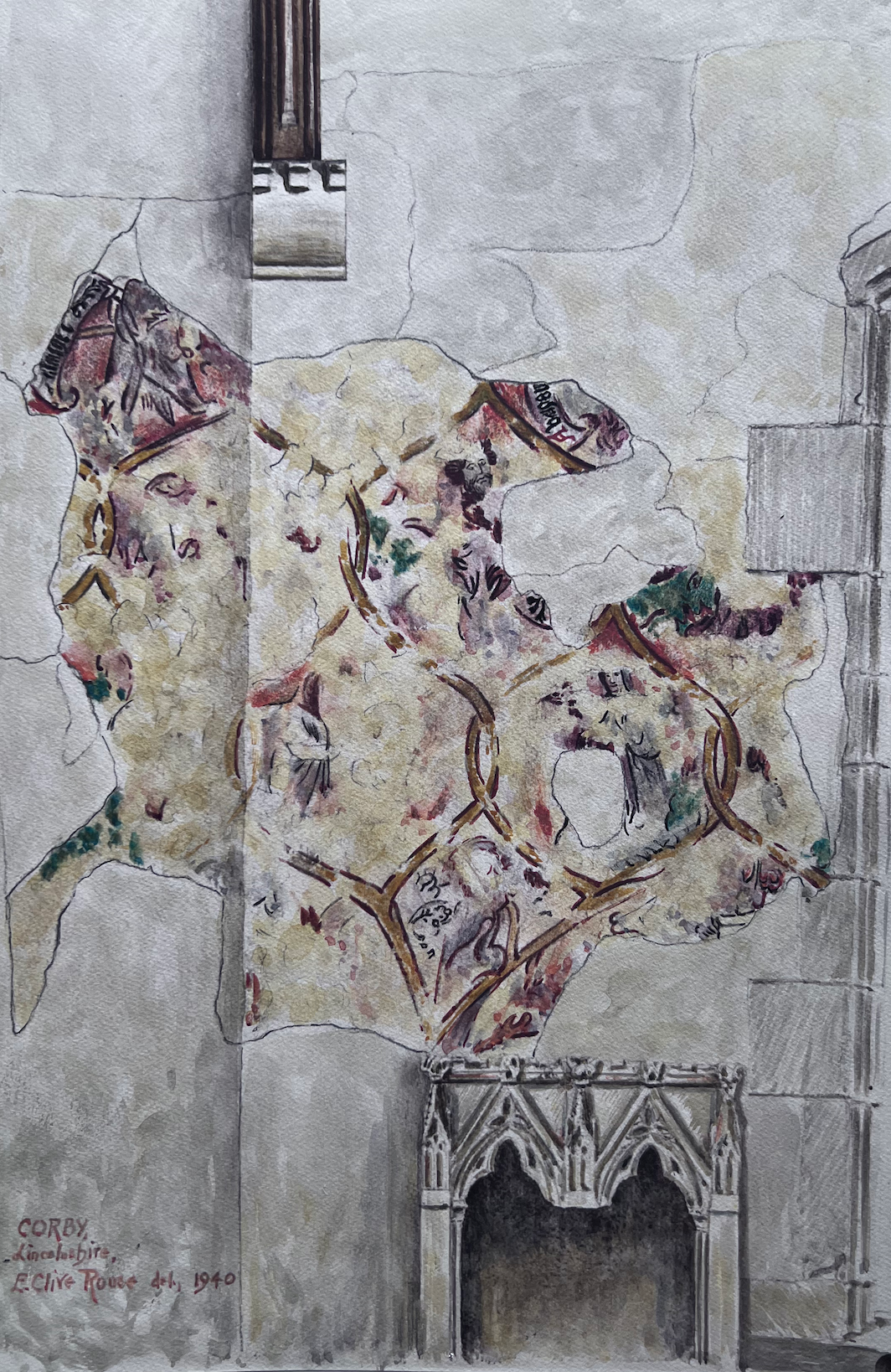




This text is taken from The Church of St John the Evangelist, Corby, Lincolnshire, and its mural paintings, by E. Clive Rouse, printed in 1941 for private circulation.
The South Aisle
Very fragmentary portions only remain of the painting in the south aisle. There was evidence of painting of various dates throughout its length; but the plaster was so perished and the subjects further mutilated by the insertion of monuments and corbels that only two small areas justified preservation. These are both at the east end.
An early scroll fragment and border
Here the earliest work is apparently contemporary with the earliest subjects in the north aisle or perhaps before, c. 1300. It consists of a beautiful and very delicate black vine-leaf and tendril scroll on a pinkish buff ground, with a border of lozenge diaper enclosing angular quatrefoils in deep red and pink. It is most unfortunate that only a small fragment of this survives.
A Jesse Tree
Owing to settlements in the masonry, building alterations and other causes, the plaster in this corner was in a very bad condition, and there were no fewer than five layers of painting superimposed, all mostly fragmentary. The best-preserved subject is that which succeeded the early scroll period, and was painted about 1380–80, the only fragment of painting of this date in the church. It is a Tree of Jesse, or the Ancestry of Christ, far less commonly met with in wall painting than in glass. In the accompanying copy [see download below] the painting of other periods has been omitted so as to make the important subject clearer.
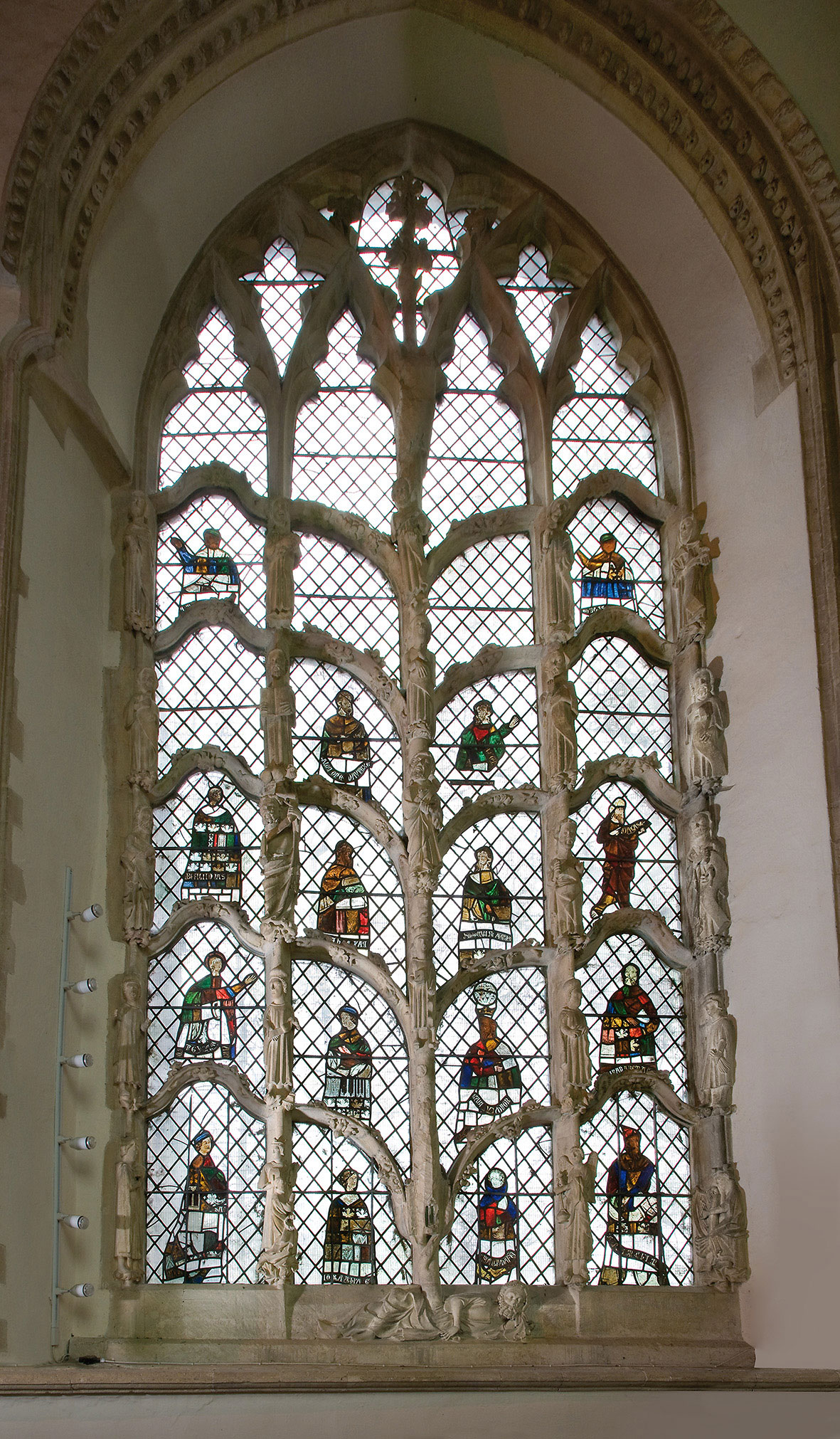
In early examples like that at Chalfont St Giles, Bucks, the tree is shown with a central stem, and scroll-like branches on which stand Kings and Prophets, David as usual being prominent. At Corby the method of presentation is well developed, and is more akin to the example in the chancel at Chalgrove, Oxon [https://reeddesign.co.uk/paintedchurch/chalgrove-tree-of-jesse.htm] and in the numerous instances of stained glass and window tracery, as at Dorchester, Oxon [https://www.dorchester-abbey.org.uk/wp-content/uploads/2015/06/jesse.jpg], Leverington, Cambs, etc.
Jesse was lying at the base (now mutilated by the re-insertion of the piscina), and from his body spring the branches of the tree which interlace regularly in a formal way to make a kind of trellis, in each compartment of which stood a figure amid foliage on a crimson background, holding a scroll or symbol to show his identity. Though very fragmentary, remains of several scrolls and three figures remain. The work is of a very high order with beautiful detail and rich colouring, the foliage being in bright green with pink and chocolate buds, the stems being yellow outlined with deep red. When complete it much have been one of the most beautiful things in the church. It is continued on the east wall and on the jambs and soffit of the east window of the aisle.
A donor’s inscription
On the south wall, below the more easterly mural tablet, is an interesting fragment, having remains of a donor’s inscription, “ORATA P ANIA”[tildas over P and I for omitted letters] (“Orate pro anima”, Pray for the soul of …), with traces of the bottom folds of the kneeling figure’s robes. The colouring is very rich, and seems to be connected with the last subject on the other side of the window, which was apparently cut through it in the early 15th century.