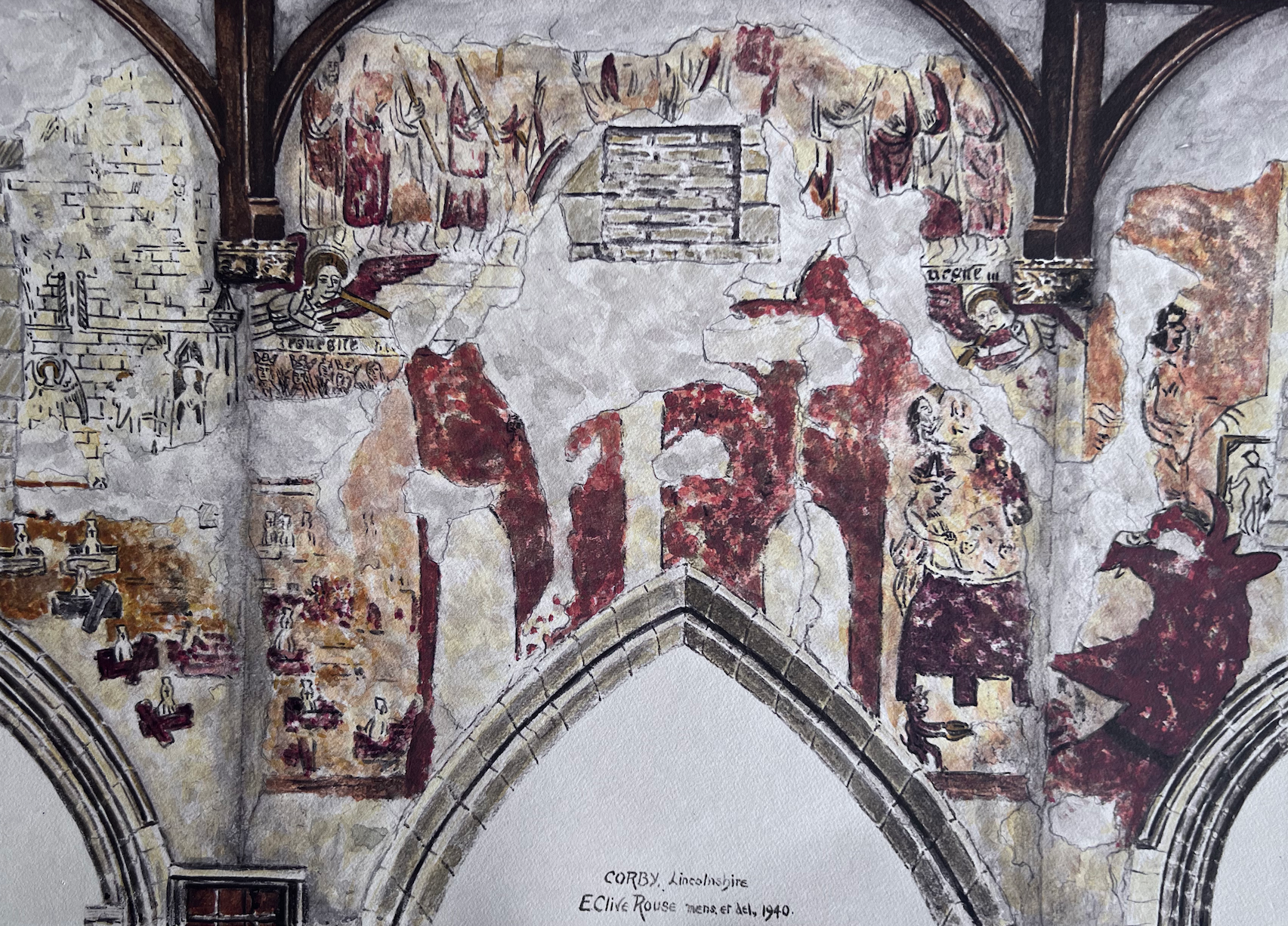




This text is taken from The Church of St John the Evangelist, Corby, Lincolnshire, and its mural paintings, by E. Clive Rouse, printed in 1941 for private circulation.
The nave
Finally we come to the great scheme in the nave, executed by the same artist or artists as the later scheme in the north aisle, c.1400 or soon after. Here we have no complication of several periods overlapping, or confusing backgrounds; but have a rare instance of an early 15th century rebuilding scheme with the whole of its accompanying painted decoration almost complete.
The Doom or Last Judgement
Above the chancel arch, and overlapping on the north and south return walls of the clerestory, in the usual position, is a great representation of the Doom, or Last Judgement. Though much mutilated on account of settlements in the wall and the perished condition of the plaster, enough remains to follow the setting out of the whole composition [download a copy of Rouse’s watercolour below].
In the centre at the top, where the blocked window is now exposed, was Christ in Majesty seated on a rainbow judging the quick and the dead. One side of the rainbow remains and the right hand upraised, and portions of drapery. This figure was flanked by a group of Apostles on each side, all barefoot and some carrying symbols.
In the zone below this are two flying Angels near each corbel, sounding a literal “last trump”, with scrolls inscribed “Resurgie Mortui”. Below the Angel on the north side is a group of resurrected souls, headed by Kings and Queens, about to received into the Heavenly Jerusalem by St Peter, shown on the north wall as masonry buildings with towers and gates with Angels at intervals.
Below this, on the east and north walls, is the General Resurrection, with souls in shrouds with a cross on the front of the face emerging and pushing back the lids of coffins.
On the other side are traces of other souls awaiting the Torments of the Damned. A demon in a pointed cap stirs souls into a cauldron, while a diminutive devil fans the flames with a pair of bellows beneath. On the south return wall is the Mouth of Hell, shown, as usual, as the open jaws of a great eared and horned monster with a baleful eye. Above is an engaging little scene of yet another demon stringing up a figure on a gallows. The figure holds a duck in one hand and another bird in the other, perhaps a playful [!!!] warning to the local poachers.
The central section of the east wall served as a plain red background, with perhaps some black diaper or brocade pattern, for the carved wooden figures of the rood group. These stood on top of the rood beam or loft, and the blank spaces purposely left unpainted, in front of which stood the Crucifix and the figures of Saints Mary (north) and John (south), are plainly visible.
The Nativity story
The spaces between the clerestory windows in the spandrels above the nave arcades are occupied by a series of life-size single figures, telling in most original and striking manner the story of the Nativity, with the Annunciation to the Shepherds and the Adoration of the Magi (Plates X and XI). It should be stated that two figures out of the scheme are missing in the western-most bay on each side. They were a shepherd and a king, and there were traces of their existence; but they were so fragmentary owing to damaged plaster caused by extensive tower repairs in 1926 that they could not be left exposed.
The Shepherds
Commencing at the west end on the south side, the first shepherd is absent as stated. Next comes an old man with beard, bare-headed and clad in a long gown of deep red. He has a russet cloak with cape-like sleeves of grey, probably intended to represent lamb- or goat-skin; and a hood that is thrown back. He carries his crook over his left shoulder with a lamp hanging from it, having apparently a floating wick. He points up at the star or the apparition of the Angel with his right hand. His flock is around and beneath him – some appear to be goats.
His companion shepherd is a young man with parti-coloured belted tunic and hose in grey-blue and red, ankle boots, and a grey shoulder-cape with scalloped edge and pointed hood worn over the head. He likewise points upwards with one hand and carries his crook and lamp in the other, but wears in addition a gauntlet glove. He also has his flock, a ram and two sheep, one looking round at his, and in addition the sheepdog (a kind of talbot) and the shepherd boy playing a pip appear.
King Herod
Appropriately next door to the Mouth of Hell is portrayed King Herod, sitting cross-legged on an elaborate throne in brown and black. He wears a very short red tunic with ermine hem and tippet, and his trunk hose are red and white. Note the enormously long shoes with little ornament at the end. He has on a kind of Eastern tiara, and carries a great curved scimitar or falchion over his right shoulder, the other hand being open in judgement, clearly intended to suggest the ordering of the Massacre of the Innocents.
The Magi with their gifts
Returning to the west end and crossing to the other side, the first of the three Magi is destroyed. The next is most sumptuously and elaborately clad in very brief doublet or tunic of brown, with ornamental belt, and hem and tippet of ermine, the sleeves slashed, and having scalloped or dagged hanging undersides. The trunk hose are brown and white. He grasps a covered cup in one hand and points with the other to a scroll inscription above him. Note the swept-up coiffure.
The other king is more simply habited in a long, white, sleeved gown of ankle length, girdled, and with ermine hem and tippet. His shoes are yellow, and long and pointed like the others. His attitude is similar, and a few words can be read on his scroll “… we offur heyr”. His coiffure is rather shaggy and hangs down – note the fashionable forked beards.
The Virgin and Child
The scheme culminates in a charming representation of the Virgin and Child enthroned. Our Lady has a close-fitting bodice and gown of pinky-red, and an ermine-lined cloak. She holds a little sceptre with fleur-de-lys finial in one hand, and supports the Child (in a red gown striped with black), his hand raised in blessing, on her knee.
At one side of the throne are remains of a fragmentary figure, perhaps St Joseph; while on the other is the unbelieving midwife; and below, the ox and the ass feeding out of the manger. All of these figures would have been familiar to the congregation from the Miracle Plays they would have seen in the big towns.