
History of St Mary's
More information about the history of St Mary's church is available. Please visit our churches to see our display boards, read our booklets, and find out more.
1st Church: 11-19th century
The present church is the third church built on this site. The Domesday Book, completed in 1086, records that 31 men and their families lived on Portsea island in the Saxon hamlets of Bocheland (Buckland), Copennore (Copnor) and Frodintone (Fratton). The church was known as the ‘Mother Church of Portsea Island’.
In 1164 AD, the Norman lord of the manor, Baldwin de Portsea, informed Henry de Blois, the bishop of Winchester, of a land transfer. In memory of his father, Alexander, He gave the church of St. Mary, together with some land, cattle, sheep and hogs; to the prior and canons of Southwick Priory.
Under the reign of the Tudors, a tower was added to St Mary's. As a settlement grew on the south west corner of the island, a chapel was built and dedicated to St. Thomas. It was run as a dependency of St. Mary’s until the 14th century. This settlement would become the fortified town of Portsmouth.
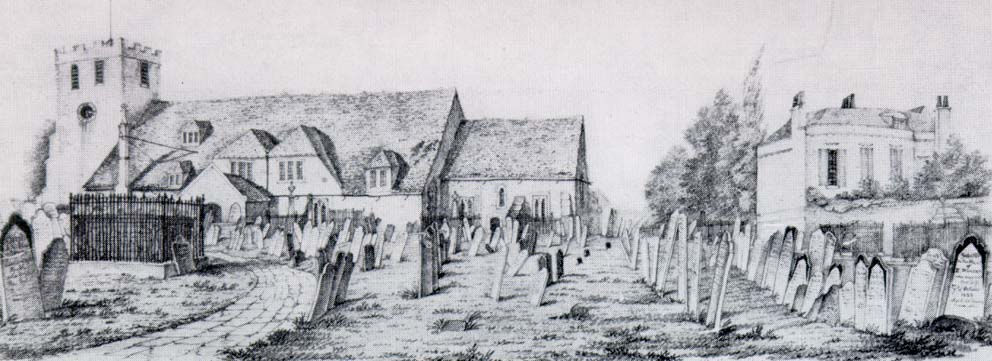
At the turn of the 19th century, a vicarage was built - it can be seen on the extreme right of the drawing c.1800. Great figures of the 19th century were baptised in St Mary's: Isambard Kingdom Brunel on 1 November 1806 and Charles Dickens on 12 March 1812. The font used then can now be found in St. Alban’s Church, Copnor.
St. Mary’s church remained in a rural environment until the middle of the 19th century, when the dockyard began to develop. As the population around the church began to grow, the need for a larger church became evident. At first a gallery was built in the church. But, in 1843, it was decided that a more drastic change was needed; the church, apart from the Tudor tower, would be rebuilt.
2nd Church: 19th century
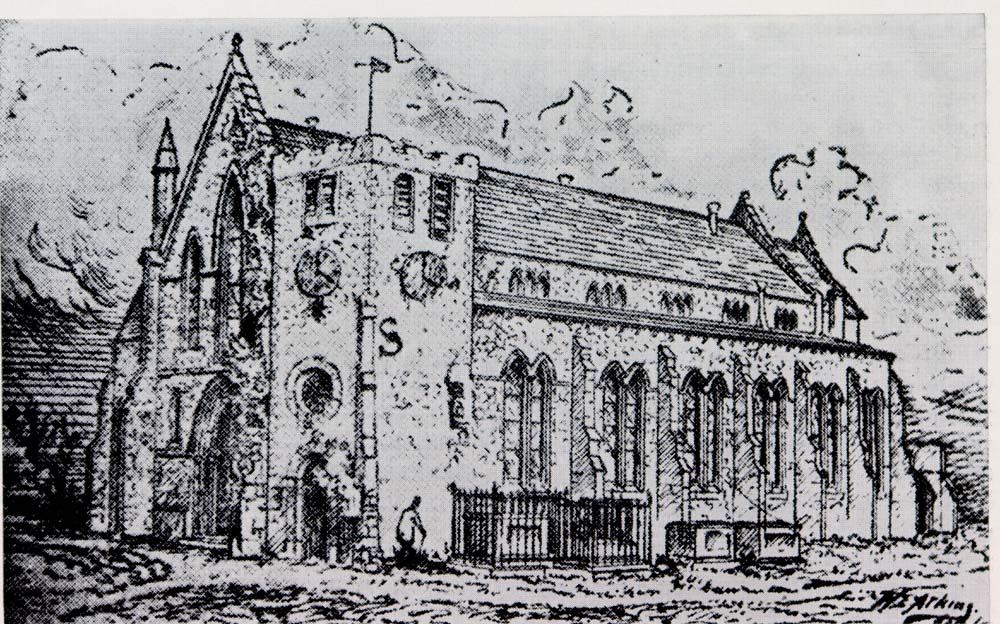
Thomas Ellis Owen, the architect who built most of Southsea into a garden suburb (including St Jude's), built the second church of St Mary in the Early English style. This second church proved to be deficient in both light and ventilation. In 1887 it was demolished and the present church was built.
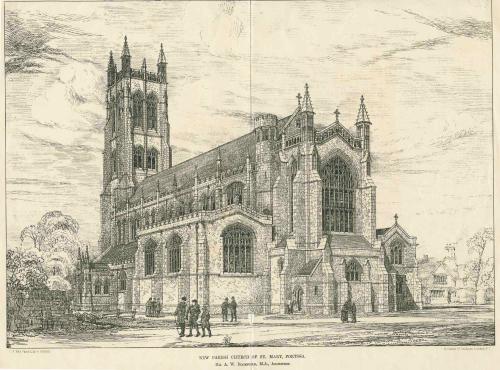
The vicar, Canon Edgar Jacob, was originally going to raise £15,000 to build a new church. But, when an anonymous layman offered to match the parish's fundraising, new plans for the present church were presented to Sir Arthur Blomfield, the diocesan architect. Upon his death on 6th October 1891, it was revealed that William Henry Smith (politician and grandson of the founder, and important business partner, of WH Smith's) was the anonymous layman. He gave £28,000 out of the £44,000 total it cost to build St. Mary’s Church.
The second church was completely demolished and a temporary iron church was erected at the north side of the churchyard.
3rd Church: 19th century - present
The present church is built in the Perpendicular Gothic style. The total external length of the church is 63.2 metres (210 feet) and the tower is 50m high (165 feet) . It is built of concrete faced with flint, with quoins and dressings of Doulton stone.
The church holds a spacious interior, with its hammerbeam roof, large pulpit and grand reredos. The stained glass windows on the north side depict scenes from the Old Testament while those on the south side depict scenes from the New Testament.
The foundation stone was laid by Victoria, Princess Royal, on behalf of Queen Victoria, on 9th August 1887. The church took just over two years to build and was consecrated by the Bishop of Winchester on 20th October 1889.
The church’s Great East Window is composed of many panes, including one featuring Christ in Glory. During the Second World War, this window was blasted out by a bomb dropped in Woodland Street. All the main panes were destroyed except for the one containing the figure of Christ.
In 1927, the Diocese of Portsmouth was created from the Diocese of Winchester. There were many debates about whether St. Mary’s should become a temporary or pro-cathedral for the new diocese. But, owing to its commitment to its mission churches, this was considered unfeasible. Instead, St. Thomas’ Church became Portsmouth Diocese's cathedral.
Mission Churches & Clergy
Canon Jacob’s vision was to build several mission churches around the parish, anchored by St Mary's at its centre. His vision was accomplished with the building of St Barnabas', St Faith’s, St Mary's Mission, St Boniface's, St Stephen’s and St Wilfrid’s.
During the Second World War, the missions of St Barnabas', St Faith’s and St Stephen’s were destroyed by enemy action. St Stephen’s used its church hall as a church but a new mission church was built in Crasswell Street named St Faith’s with St Barnabas in 1957. Due to the financial situation facing the parish in 1961, the missions of St Stephen’s, St Mary’s Mission and St Boniface were closed. Similarly, St Wilfrid's church closed on 20 November 2022; the building found a new use with the Redeemed Christian Church of God.
Many of the vicars of St. Mary’s have become archdeacons and bishops. The most notable of these was Most Rev. Cosmo Gordon Lang, who served as vicar of St Mary's from 1896 to 1901 and went on to become the Archbishop of York in 1908 and then the Archbishop of Canterbury from 1928-1942. Cyril Forster Garbett, vicar of St Mary's from 1909 to 1919, also became the Archbishop of York in 1945.
The Sinking of HMS Royal George
It was during the reign of George III that one of the most tragic maritime disasters happened. On 29 August 1782, while anchored in the Solent, the ship rolled out of control during a maintenance operation, took on water, and sunk, resulting in the loss of about 900 lives, many from Portsmouth. 35 bodies were interred in one grave at the south east corner of St Mary's churchyard and a memorial was erected to all those who lost their lives during the incident.
The Royal George
When the Royal George was launched on 1 February 1756, she was deemed “The paragon of beauty and perfection in the science of marine architecture, her force nominally exceeded any other ship of the world’s navies”. Her three masts were over 100 feet in height and she was decorated with more flags than any other ship in service. The ship cost £54,664 to build, she had:
- an extreme breadth of 51ft. 9.5ins,
- a depth in the hold of 21ft. 6ins,
- a gun deck that was 178ft long
- 108 guns
- a keel length of 193ft. 5.5ins
- a burden of 2046 tons
Lord Anson, Admiral Boscowen, Lord Hawke, Lord Rodney, Lord Howe, Sir John Lockart Ross were among the officers who had commanded her.
History of the Royal George
Upon the outbreak of the Seven Years' War in 1756 the Royal George took her place as the flagship of the Channel Fleet. In 1759, at the Battle of Quiberon Bay off the south coast of Brittany, she knocked out two enemy battleships with only two broadsides.
When the war came to an end the Royal George was laid up in Plymouth. In 1778 she sailed against the French. In 1780 she captured two Spanish battleships off Portugal. Then, for two years, she was overhauled to bring her up to scratch with the front line of Britain’s navy. She was declared fit for service in March 1782.
Rear Admiral Richard Kempenfelt, Commander of the Royal George on the day it sunk:
Rear Admiral Richard Kempenfelt was born in London in 1715. The Kempenfelt’s were a distinguished noble family in Sweden: his father Magus was an officer in the Coldstream Guards and later the Queens Regiment, he died in 1727 while Lieutenant Governor of Jersey.
Kempenfelt served some of his service as a Flag Captain. It was during the East Indies operations that he became aware of the Frenchman, La Bourdonnais, who wrote a treatise on flag signals. Using this as a base, he was able to craft a set of flag signals that were used in the American War of Independence. By July 1782, they were firmly in place and were used by Lord Howe in the relief of Gibraltar. Later, Lord Nelson was able to use these signal reforms while seizing his victory at Trafalgar. Kempenfelt served with Admiral Edward Vernon at the capture of Portobello in 1739 - Admiral Vernons was nicknamed “Old Grog” after his Grogram Cloak; when he introduced diluted rum to the Navy it was called “Grog”.
Kempenfelt had an interest in the health of those on board his ship. When Captain John Jervis (later to be Lord St. Vincent) was ill with influenza, Kempenfelt sent Lt. Philip Durham with a basket of fruit and his compliments for an early recovery.
Kempenfelt’s most famous exploit was, against overwhelming odds, the cutting up of a French convoy near Ushant on 12 December 1781. It was regarded by the French as a most daring and brilliant feat. He only had 12 ships, including his flagship H.M.S. Victory, while the convoy had 19 warships, 23 armed en flute, and an overwhelming number of men and guns.
The Accident
In August 1782, a Grand Fleet was assembled, under Lord Howe, to relieve Gibraltar from their siege by the French and Spanish. At this time, the Royal George sailed from Plymouth to the Solent to join the 50 'men of War' and 200-300 merchant ships which had been assembled in the Solent. The Royal George's size would have helped her stand out among the 36 battleships; she was even one of the largest of the 6 three-decked ships, alongside HMS Victory. At this time, the ship was commanded by Rear Admiral Richard Kempenfelt, captained by Captain Waghorn, and navigated by Richard Searle, the Master.
Before sailing, Captain Waghorn ordered that a minor repair be done to a pipe just below the waterline. The pipe was on the starboard side, which let salt water into a cistern before being pumped up again for washing the decks. The seacock needed either repairing or replacing. To do this, Captain Waghorn decided to heel (lean) the ship over until the pipe was clear of the sea; this would require running out the larboard or port guns and running in the starboard guns. The Master Attendant of Portsmouth Dockyard, William Nichelson, did not approve of using this method while the ship was being loaded with 548 tons of stores and 83 tons of ammunition.
Nevertheless, at 7am on 29 August 1782, the 820 strong crew began to push the cannons - which weighed over 2 tons each - into position, until the 8° list was obtained. All might have been well except for two decisions:
- This was the day that about 360 were to be ferried by ‘bumboats’ to the Royal George to say their farewells or trade with the sailors - given that half of the crew had probably been conscripted by press gangs, shore leave had been banned across the fleet in case of abandonment. This mean that the upper gundeck was crowded with wives and children, tinkers, hawkers and prostitutes.
- The 50-ton cutter, Lark, was still allowed to unload barrels of rum through the Royal George's portside gunports, even though they were less than one foot (30.5cm) from the sea and navigating a choppy floodtide. No one seemed to be in charge of operations below decks: the Master had gone to visit his wife, who lived in Marlborough Row, Portsea; and the Boatswain and the Gunner were in Portsmouth despite the ban on shore leave. The officers were chatting on the quarter deck about the ship being “out of discipline” on such occasions. At first, the barrels of rum were being unloaded and rolled up the sloping deck, until they decided to just stack them as the barrels came aboard. This added more weight on the side causing the sea to come in.
The Carpenter, realising the danger, hurried to the quarter deck to tell the officers and to “rightship”. Unfortunately, he did not know that Lt. Philip Durham was the Duty Officer and instead went to the short tempered Lt. Hollingsbury, who gave him a short answer and sent him below. When he came up a second time, he was rebuked again. Similarly, Captain Waghorn had tried to warn Rear Admiral Richard Kempenfelt in his cabin, but the cabin door had jammed.
When the Royal George heeled over before she sank, Lt. Durham was plunged into the sea from the quarter deck. Having already thrown off his coat, he was soon washed away and left floating about amongst men and things from the ship. Those not able to swim caught hold of those who could, resulting in them all being dragged down and drowned; Lt. Durham was twice dragged by a marine who clung to his waistcoat, who refused to let go despite Lt. Durham's pleading. Eventually, Lt. Durham managed to unbutton his waistcoat and free himself from the unfortunate marine, who immediately disappeared - two weeks later his body was washed up with the waistcoat still wrapped around his arm. Lt. Durham was clinging to some rigging when a boat came to pick him up, but, seeing that Captain Waghorn was in danger, he directed the boat to rescue the captain instead. He was later picked up by a boat which took him to HMS Victory, Lord Howe’s flagship, where he stayed and proceeded to sea three days later.
Captain Waghorn survived, but his son drowned. Such was the speed at which the Royal George sank that most were trapped below decks. About 70 were picked up by the boats from other ships, among whom were four lieutenants and eleven women. The Master and the Carpenter both drowned, along with Rear Admiral Kempenfelt. Lt. Hollingsbury survived, as did most of those composing the watch upon deck. One of the sheep kept on board was seen swimming about with a small child clinging to its wool. The child was rescued by a wherryman, but later found out that both his parents had drowned. He only knew his name was Jack Lamb.
Of the 1200 people on board, including about 300 women and children, 900 were drowned. Almost everyone in Portsmouth had lost a relative, friend or acquaintance in the tragedy.
The Aftermath & Memorials
A court martial, consisting of 5 admirals, was convened on board HMS Warspite. They said that the bottom of the ship had fallen out through rot, blaming the disaster on the dockyards authority and the Navy Board. This disaster was not unusual: funds for the repair of ships were often found lacking and so ships went to sea in a dangerous condition.
Of the survivors, Lt. Hollingsbury became a Captain and Lt. Philip Durham was knighted and became Rear Admiral as Commander in Chief of Portsmouth from 1836-1839. He married Ann Henderson, who inherited Eastney Farm and part of Milton. In 1858-60 the Henderson–Durham’s sold 50 acres of their estate to the War Dept. and Eastney Barracks was built. They also gave the land on which the first church of St. James was built.
Bodies were washed up all around the Solent. Some were buried in Ryde, near the shore. 35 bodies were interred in one grave at the south east corner of St. Mary’s churchyard. These were some of the first bodies to be interred in new ground that had been purchased, from Samuel Leake on 5 November 1781, to enlarge the churchyard by 2 acres, these being the first to be interred in the new ground. A headstone was erected at the grave of the 35 victims buried in the churchyard which read:
A testimony of
sympathy
for the unfortunates
who perished by the sinking
a spithead of the
H.M.S Royal George
August 29th 1782.
erected by one who
was a stranger both to officers
and the ships company
In the 1970s, the tombstone was sent to a stonemason to have the wording re-cut, because of its weathered condition. It was forgotten, until being found in a store belonging to the city museum and returned to St Mary’s in 1991. This headstone can now be seen under the tower of St Mary’s church.
In a vestry meeting of the Parish of Portsea, held on 28 November 1782, the parish agreed to erect a memorial to those who had lost their lives in the accident. It was made by James Hay, a local mason (who was also interested in local history and associated with Portsmouth's first museum) in black and white marble. The wording read:
Reader, with solemn thought.
survey this grave and reflect on the untimely death
Of thy fellow-mortals; and whilst
As a man, a Briton, and a patriot, thou read’st
The melancholy narrative, drop a tear
For thy country’s loss.
On the twenty-ninth day of August 1782,
His Majesty’s Ship the Royal George being on
the heel at Spithead over set and sunk;
by which fatal accident
about 900 persons were instantly launched into
eternity amongst who was that brave and
experience officer Rear-Admiral Kempenfelt.
Nine days after many bodies of the unfortunate
floated; Thirty-four of whom were interred
in one grave, near this monument, which
is erected by the Parish of Portsea,
as a grateful tribute to the memory of
that great Commander and his fellow-sufferers.
'Tis not this stone, regretted chief, thyname,
Thy worth, thy merit, shall extend thy fame;
Brilliant achievements have thy name imprest
In lasting characters on Albion’s breast.
At a further vestry meeting on 22 April 1783, it was agreed that an iron railing be erected for the protection of the Royal George monument.
When the churchyard was made into a rest garden in 1935, the parish recognised that the James Hay memorial was in too dilapidated a state to be renovated. It was decided that a new memorial would be made in the style of a Celtic cross on a base and that the old memorial would be buried under it. The Bishop of Portsmouth suggested the following inscription:
Front:
This stone is placed here in memory of
those who lost their lives in the Royal
George which sunk at Spithead on the
twenty ninth day of August 1782 with
a loss of about nine hundred lives.
The original Royal George Memorial
stone, owing to its dilapidated
condition, was removed from the
south-east corner when the churchyard
was made into a rest garden in 1935.
Back:
In memory of those who have lost
Their lives in nearby waters
- Revelations 20:13
Due to vandalism, all that remains of the memorial is its base.
On the anniversary of the tragedy, a floral arrangement is placed by the tombstone under the tower and the victims are remembered in our prayers. There is a memorial to Admiral Richard Kempenfelt in St. Michael’s Chapel at Westminster Abbey.
The Wreckage:
In 1783, William Tracey attempted to raise the Royal George by slinging her. He managed to shift her about 30 yards to the west before the weather stopped any further work continuing. The following spring, the Navy Board said that “no further assistance will be given to raise the Royal George”.
In 1832 the Navy Board was abolished. That same year, John and Charles Deane, the inventors of the deep sea diving suit, descended to the wreck and found her to be an indescribable mass of decayed timber and material confusedly mixed with mud, clay and soil. Following this, many of the guns and quantities of her stores were recovered.
In 1839, Colonel Pasley commenced operations for the removal of the wreck by the use of divers and blasting operations. On 11 May 1840, it was blown up using 2400lbs of explosive. Immediately after the explosion, the operation was suspended because of the mad scramble by small boats to reach the mass of dead fish which had been blown to the surface, as well as candles from the Purser’s store.
Relics from the Royal George are to be found in many places:
- A 32-pounder gun was at the entrance to Pembroke Gardens, Portsmouth. On 15th November 1836, it had been raised by James Deane and presented by the Board of Ordnance to General Durham of Largo, Lt. Durham’s elder brother, on January 1837;
- 2 guns are near the entrance to the tower of Etal Castle, Northumberland;
- A gun from the “Royal George” can be seen at Southsea Castle;
- A binnacle of the ship is on the quarter deck of H.M.Y. Britannia;
- Timber from the ship was used in various ways – fences, book covers, boxes for snuff, etc.;
- The bell of the Royal George was hung in the cupola of the chapel in Portsmouth Dockyard
- Some of the cable from the ship was given to St. Mary’s church.
The impact of the sinking of the Royal George upon the parishioners of the parish of Portsea was considerable: even a hundred years later, when the present church was being designed, the Great West window was to be dedicated to the victims of the tragedy. However, when W.H. Smith died suddenly just after the present church was completed and his status as the church's anonymous donor was revealed, it was decided that this window be dedicated to his memory.