
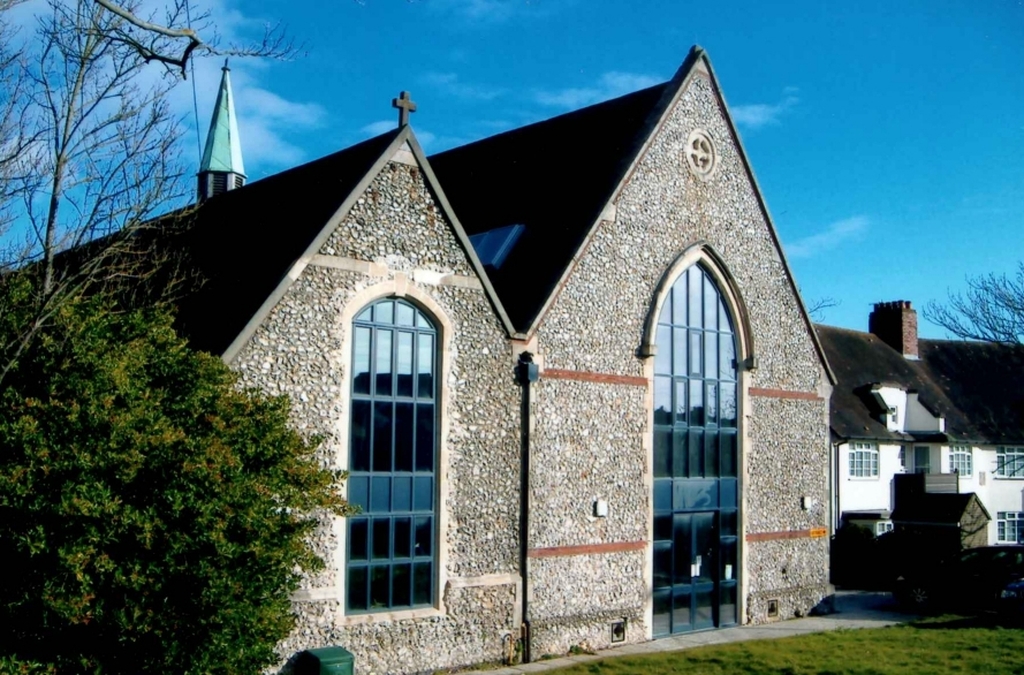
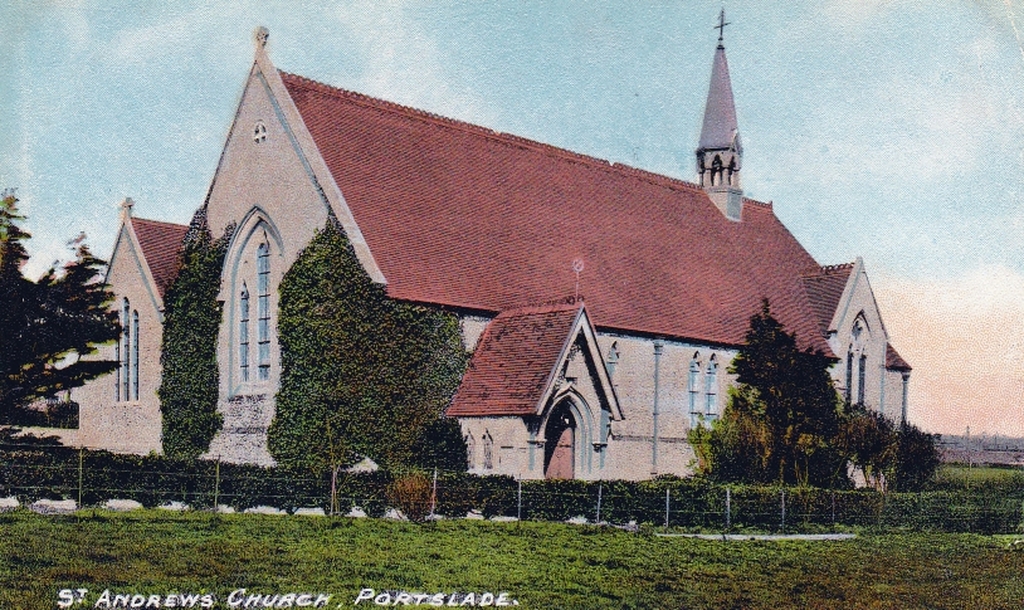
Revd F.G. Holbrooke was Vicar of Portslade from 1859 to 1880 and it was during his time that it was decided to build St Andrew’s Church to serve an area of growing population in the southern part of the large parish. In those days it was known as Copperas Gap (later on it became Portslade-by-Sea) and the new church would also serve the people of Fishersgate. The two areas had a population of around 550 people in each and there was to be enough seats for 300 people at St Andrew’s.
The Hall family owned land at Portslade and lived there too but when Revd William Hall donated the site for the new church, he was Rector of Saxham Parva, Bury St Edmunds. Although the donation only concerned enough land for a church building, it was hoped that extra land for a churchyard might be forthcoming at a later date. But Revd Hall refused to countenance the idea. By this time the situation was becoming serious because the small churchyard around the ancient Church of St Nicolas was full up; this is the reason why in 1871 Portslade authorities sought to establish a new burial ground elsewhere.
This was not the only difficulty surrounding the birth of the new church. Apparently, the Rector of Southwick felt aggrieved because his views on the matter had not been taken sufficiently into account. He seemed to regard Copperas Gap as being within his sphere of responsibility and he may well have been right. He felt that parish boundaries should have been sorted out well before the church was consecrated. Instead it was the other way around and the Rector felt there had been some sort of behind-the-scenes agreement between the Bishop of Chichester and Revd Holbrooke. It is a fact that the choice of a clergyman for the new church became the responsibility of the Vicar of Portslade.
t is possible this row had something to do with the Hall family who donated the site for St Andrew’s in the first place. Perhaps they also expected to exert patronage over the new parish. The Hall family had considerable land holdings in Portslade dating back to 1795 when Nathaniel Hall purchased Portslade House Estate consisting of 272 acres. The Hall family also owned land in Southwick including the site where the Roman villa was once located. There was a family vault at the Church of St Michael and All Angels, Southwick. Possible the fall-out over patronage and boundaries led to the refusal to make land available for a churchyard.
A Famous Architect
Edmund Evan Scott practised as an architect in London before moving to Brighton in 1853 and by the 1860s he was working from premises in Russell Square; by 1871 he was established at 46a Regency Square. His first partner was a Mr Suter and the two of them designed St Andrew’s Church, Portslade. On his own account Scott designed the Brackenbury Schools, Locks Hill in 1872 and the chapels in Portslade Cemetery at around the same time. It is likely he designed the Brackenbury Chapel at St Nicolas too.
Later on he became associated with nearly all of Wagner’s church-building and church-enhancing schemes at Brighton, including the Church of the Annunciation, St James’s Church, All Souls’ Church and with his later partner designed St Saviour’s Church. But by far his most important work was St Bartholomew’s, Brighton, a building of such size and magnificence it is impossible to ignore.
It is interesting to note that while Scott’s Portslade buildings made great use of local flints, St Bartholomew’s was an essay in red brick. St Andrew’s, Portslade was designed in the early English style with a fleche. The total cost came to £1,541 and included the surrounding walls and gates; Cheesman & Co built the church. The money came from public donations, grants from the Diocese of Chichester, and also from the Incorporated Church Building Society. The church was opened in 1864.
The Bishop of Chichester dedicated the St Andrew’s Church on 18 October 1864. It became so popular that soon 300 sittings were not enough for all the people wanting to attend. Plans were prepared for the building of a north aisle, which would provide 150 extra seats.
The Bishop of Chichester laid the foundation stone on 21 June 1890. The Bishop was attended by Revd Canon Borrer, who acted as his chaplain. Mrs Richard Smith, Miss Sharp and the Misses Powell were responsible for the floral decorations and there were some splendid vases of white flowers on the Communion Table. ‘The pulpit was trailed with ivy, relieved with blossoms, a handsome basket of flowers hung in front of the reading desk and there was a profusion of flowers in front of the choir stalls.’
The well-known London architect Reginald T. Blomfield prepared the plans and Mr Peters of Horsham was the contractor. The new north aisle cost £911 and already by the time of the stone-laying ceremony some £600 had been collected. The money came from donations by the congregation and from the proceeds of bazaars, concerts and outside appeals. The building committee contained a host of well-known Portslade men such as W. Dudney (Portslade Brewery), Frederick Sundius Smith (Britannia Mills), J. Blaker, J. Miles and Councillor W. Hillman J.P. It was hoped the existing vestry would eventually be removed, and a new vicar’s vestry and choir vestry built with the organ chamber over them.
For a detailed history with photographs , see:- St Andrew’s Church, Portslade
Copyright © J.Middleton 2016