
Revd Richard William Enraght (1837-1898)
In 1872 Revd Richard William Enraght arrived in Portslade with his wife Dorothea and their children. The Enraghts had seven children altogether and their fifth child, a daughter called Grace, was born while they lived at Portslade. They lived at Courtney Terrace in a house now numbered as 5 Station Road.
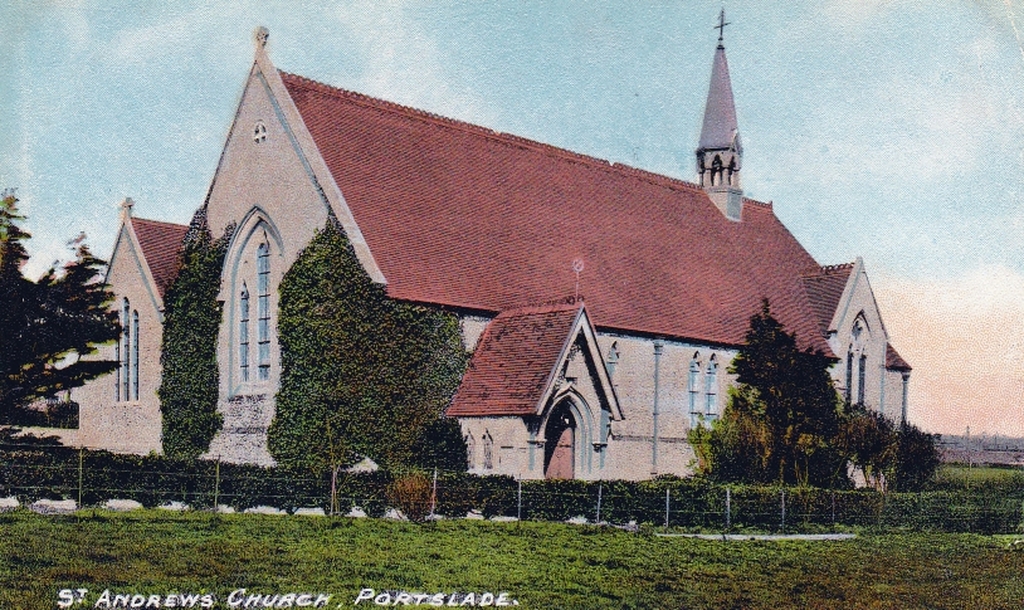
Revd Enraght was appointed curate-in-charge of the newly created parish of St Andrew, Portslade and St Helen, Hangleton. It is interesting to note that Revd Holbrooke, as vicar of Portslade, had the power to appoint a priest to this parish of his own choosing. This meant that he must have been entirely aware of Enraght’s strong leaning towards Anglo-Catholic practices at a time when the Established Church was still predominately Protestant. After all, before moving to Portslade, Revd Enraght had served as curate at St Paul’s, West Street, Brighton, which was famous for its high church ceremonies.
It seems evident that Revd Holbrooke held progressive views. For example, when St Andrew’s was opened it was unusual in not charging pew-rents, which had been the norm in the Church of England. Revd Enraght thoroughly agreed with their abolition because he felt it was unfair to poorer folk. This meant that St Andrew’s was open to all and nobody could ‘buy’ a pew.
In 1872 while he was living in Portslade, Enraght published two powerful pamphlets entitled The Real Presence and Holy Scripture and Catholic Worship. It may be that Gosset read it and that this was the cause of his anger.
Frederick Richard Mealy Gosset was a retired officer of the Bengal Army and lived in a stately Georgian house called simply Portslade House at the western end of High Street. Gosset was obviously of a strict Protestant persuasion because he was outraged by Enraght and stated the clergyman adhered to the Church of Rome in all but name. Enraght could not let such a comment pass by and wrote a letter to Brighton Gazette protesting at such a slander.
The Enraghts left Portslade in 1874. But Father Enraght continued resolutely on his path towards Anglo-Catholic worship and being unpopular with the Establishment did not deter him. Indeed, he was so convinced of the rightness of his beliefs that he was prepared to spend 49 days in Warwick Jail after he was convicted of breaking the law as laid out in The Public Worship Regulation Act; even the man in charge of the jail thought it was quite wrong that the clergyman should have been sent to prison. Thus the Revd Richard Enraght became famous in England and the USA as a Prisoner of Conscience.
Copyright © J.Middleton 2016